3 The World Around Varenhold
This chapter is fully player-safe. Read it before or between sessions.
Optional narration:
Full-page narration (Graymere overview through the city’s golden age):
3.1 The Graymere Reaches
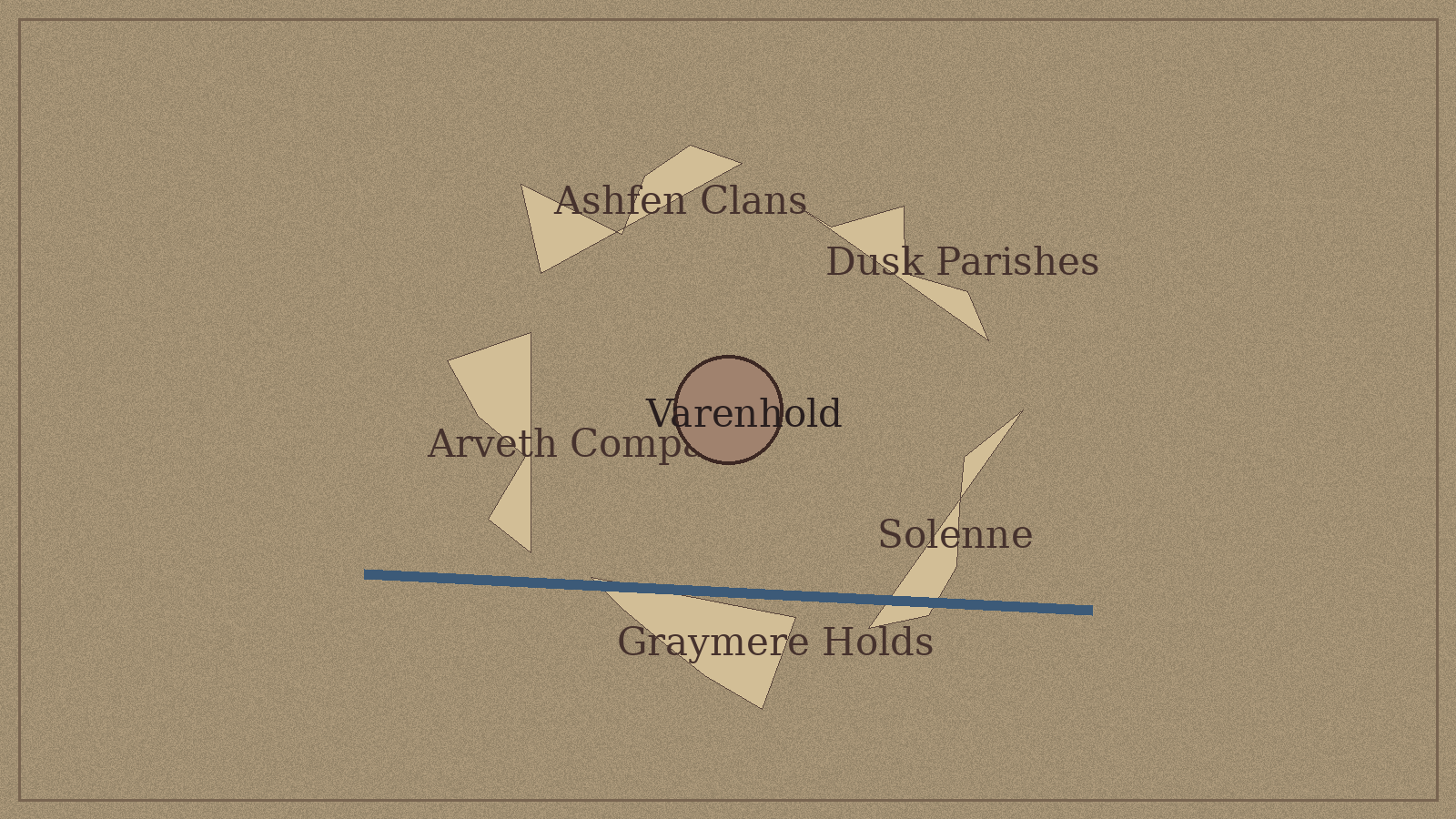
Varenhold sits at the center of a region called the Graymere Reaches - named for the broad, slow river that drains the mountain snowmelt southward into the marsh country before eventually reaching the sea. The Reaches are not a nation. They are a geographic convenience, a name traders use for the loose collection of cities, parishes, clans, and mountain holds that share the same river valley and, historically, the same trade routes.
For most of the Reaches’ recorded history, this arrangement worked well. Each power had something the others needed. No single nation was strong enough to conquer the rest. The river kept commerce moving, and Varenhold sat at the crossing where the eastern and western roads met the northern mountain passes.
Then the sun went out.
3.2 Varenhold: The Crossroads City
3.2.1 What Varenhold Was
Two hundred and fifty years ago, Varenhold was a minor fortified settlement at the junction of three trade roads. Its founders were practical people - merchants, retired soldiers, a handful of scholars who followed the merchants for the libraries - who saw that whoever controlled the crossing point would prosper regardless of what any particular nation needed that season.
They were right. Within fifty years, Varenhold had grown into a city. Within a century, it had a university district (the Spire), three competing merchant guilds (now consolidated into one Compact), and the diplomatic infrastructure of a major regional power without ever formally becoming one. Varenhold did not conquer. It facilitated. It taxed transit, brokered disputes, trained scholars that all the neighboring powers needed, and maintained a studied neutrality that made it useful to everyone.
The city’s golden age ran roughly from 100 years ago to the night the sun vanished. Scholars estimate the population then at around sixty thousand. The architecture of the Highmark district dates from this period: broad arcades, public fountains, the Amber Hall where the city’s famous amber-lantern concerts were held. Varenhold had developed a reputation for a particular kind of beauty - not grand or martial but intricate, golden, warm. The city’s amber workshops were famous throughout the Reaches. Artists came here to study the quality of the light.
The light has changed since.
3.3 The Last Day Before
The day before the ritual. Not history - memory. Five people who were there.
Audio retelling:

It was hot.
That’s the thing nobody writes down in the history books because it seems too small, but the people who were there say it first: it was hot, that last day. A late-summer heat with no wind, the kind that makes stone walls feel warm even after dark. The market smells were stronger than usual - preserved fish, lamp oil, the sweetness of the amber-lantern workshops at full production in the Dawnhalls district. Shadows everywhere. Long ones in the morning, short ones at noon, long again by afternoon, the specific way a shadow tells you where the sun is by its direction and angle. Nobody thought about this. Why would they?
Children played in the plaza near the Ashring. The ritual stones had been installed three years before and were still new enough that parents were careful about letting kids climb on them - the Spire had put up signs asking people not to touch the Primer Stones, and most people respected this in the way you respect a sign when you’re an adult. The children didn’t respect it. Sera Voss was born at 11:47 that night. She weighed seven pounds.
The amber-lantern workshops in the Dawnhalls district ran a full shift. There was a concert in the Amber Hall at seven - the conductor was introducing a new work, something composed specifically for a particular calibration of warm light. The Amber Hall sold out months in advance. Forty-two people stood outside waiting for returns that didn’t come. Most of them went home. A few stayed and watched the light from the Hall’s windows and listened through the walls.
The Archive closed at five. Theron Waide, twenty-two years old and two months into his position as Archive Assistant, was the last person to lock the lower floors. He took the long route to the exit because he always liked the smell of the old paper in the east stacks. He was outside by five-thirty, in the heat, walking home to the Spire Quarter. He remembers thinking about dinner.
At 10 PM, the Archmagister lit the first of the Primer Stones.
Five people who saw the Night. Fifty words each.
Nessa, age 30, Lowmark resident - now 80, maintains the Dawnhall memorial room:
The light from the Ashring was visible from my window. Blue-white at first, then amber, then I don’t have a word for what it turned into. The ground felt strange. Like the city was breathing differently. Then it stopped. And the next morning - no sun. My neighbor knocked on my door and said: “Something’s wrong.” I said I knew.
Cova Drell, age 45, dockworker and father of Cormac - died Year 23:
I was at the Ashring. Watching with the others. Thousands of us. The Archmagister was brilliant - even from the back of the crowd you could feel what he was doing. Then something tore. The air tore. And all the babies in the Lowmark started crying at once. All of them. I had never heard anything like it. I didn’t sleep until the second day.
Scholar Innis, age 60, retired from the Spire - died Year 35:
I was in the Spire watching through instruments. My job was to record the ambient field readings. The readings were consistent with Corven’s predicted model right up until Step 9. At Step 9, every instrument I had went to maximum and held. I still have the charts. The numbers on them are impossible under any theory I understand. I’ve spent thirty years trying to understand them.
Hessa, age 19, Auris temple novice at the time of the Night:
The High Priest was praying in the Cathedral when the ritual began. He stopped mid-word. We all felt it - not pain, something stranger. Like the air had decided something. He turned to us and said: Auris is moving. I’ve thought about those words for fifty years. Moving toward what? Moving away? I don’t know. I don’t think he knew either.
Aldric Stone, age 0, Dawnborn - born during the Night:
(Interviewed Year 48; Aldric was told the birth story by his mother before she died in Year 31.) She said I was early. She said the labour started when the light from the Ashring changed - she could see it from the hospital window. She said I came out facing the wrong direction, which apparently meant something in old Varenholder midwifery tradition. She said I glowed faintly for about three days. She thought that was beautiful. She never stopped thinking that was beautiful.

3.4 Varenhold Through Time: A 250-Year Chronology
Varenholders do not count years from a monarch’s birth or a founding charter. They count from the Night of the Ritual - Year 0, the night the sun stopped rising. Everything before that is “Before” (abbreviated B), everything after is numbered.
| Era | Year | Event | What Changed |
|---|---|---|---|
| Founding | ~250 B | A fortified trading post established at the river crossing by a consortium of eight merchant families | Varenhold exists |
| ~220 B | The three trade roads formalized as “the Reach Roads” - the crossroads becomes an official waypoint | Transit tax revenue begins | |
| ~200 B | Population reaches five thousand; the first guilds chartered | The city becomes a city | |
| The Golden Era | ~150 B | The Spire founded - initially a single tower for a single scholar; expands within a generation | Scholarly reputation begins |
| ~130 B | First amber lanterns produced commercially in what becomes the Dawnhalls district | The export that will define Varenhold | |
| ~100 B | The Amber Hall completed; the lantern concert tradition formally established | Cultural golden age begins | |
| ~80 B | Population peaks at approximately sixty thousand | The city at its largest | |
| ~70 B | The Merchants’ Compact charter signed, unifying three competing guilds | The Compact’s lasting institutional shape | |
| ~60 B | Varenhold brokers the Treaty of the Reach Roads - a formal neutrality agreement between Solenne, the Compact, and the Holds | The city’s most important diplomatic achievement | |
| The Ritual Era | ~20 B | Archmagister Corven appointed to head the Spire’s Theoretical Division | The beginning of the end |
| ~15 B | Corven’s first publication on “solar amplification through sympathetic binding” - widely celebrated | The academic groundwork for the ritual | |
| ~10 B | Construction begins on the Ashring: a permanent outdoor ritual space in the city plaza | The ritual is becoming real | |
| ~5 B | Corven approaches the High Penitent of Solenne for formal religious approval of the ritual | The only approval he seeks outside Varenhold | |
| ~2 B | The Primer Stones installed in the Ashring; preliminary ritual tests conducted (limited effect) | The ritual infrastructure in place | |
| 1 B | Corven declares the ritual ready; city council approves; public announcement made | Half the city plans to watch | |
| Year Zero | 0 | The Night of the Ritual: the Ritual of Eternal Dawn performed; something goes wrong; the sun stops rising | Everything |
| 0 | Ten children born across the city in the hours following the ritual - premature, healthy, faintly luminous | The Dawnborn arrive | |
| 0 | Corven found dead in the Ashring; the cause is listed as “backlash”; the ritual documents sealed by his assistant | The truth begins to be buried | |
| The First Winter | 1 | Crop yields fall fifteen percent; the first serious food shortage in Varenhold’s history | The city realizes this is not temporary |
| 2 | The Spire begins formal investigation of the twilight mechanism; initial estimate is “a few months to resolution” | The optimism that will not survive | |
| 3 | The first Dawnhall established in the Lowmark - originally an emergency food distribution point | The institution that defines the next fifty years | |
| 5 | Population begins declining; the first significant emigration wave, mostly younger families | Varenhold loses twenty percent of its people in the decade | |
| 8 | The grey sickness formally named and described by Healers’ Guild - an affliction that seems connected to the absence of sunlight | The second great crisis begins | |
| 10 | The Dawnborn, now ten years old, begin exhibiting abilities - strength, insight, healing - that no one can explain | The city’s protectors appear | |
| The Compact Era | 15 | The Merchants’ Compact formally establishes the credit-writ system to stabilize commerce | The economic adaptation that works |
| 20 | The Restorer movement formally organized - previously informal grief circles become a structured advocacy group | Political pressure for restoration begins | |
| 22 | The Desperate Winter: food stores drop to fifteen percent; Dawnhalls ration for four months; political unrest; the Dawnborn Lira begins developing her compound | The closest the city came to collapse | |
| 23 | Lira’s first grey sickness compound distributed through the Healers’ Guild - partial management, not cure | The city’s health stabilizes somewhat | |
| 25 | The Spire’s hundredth paper on the twilight published; still no consensus on mechanism | Fifty years later, this number is over three hundred | |
| 30 | The first mark debasement - the city begins recoining copper marks at lower content | Economic strain made visible in the currency | |
| 35 | The Dawnborn, now adults, become formal public figures; Sera stops a building collapse that would have killed forty people | The Dawnborn mythology solidifies | |
| The Quiet Decades | 35-45 | Relative stability: food supply managed, grey sickness managed, amber lanterns funding the economy | The years that felt like progress |
| 40 | Tomas Areth establishes the informal arbitration system in the Outer Ring that becomes the city’s primary dispute resolution | Tomas at his most effective | |
| 42 | Archivist Theron Waide discovers the sealed ritual documents in the Archive lower levels | The information that changes everything - and that he tells no one | |
| 45 | The Dusk Sitting tradition formally established - previously informal grief gatherings become civic ritual | Varenhold names its grief | |
| The Recent Era | 45-50 | The grey sickness rate begins climbing again; food stores declining; trade partners pulling back | The slow deterioration accelerates |
| 47 | Chancellor Mira Ostenveld elected; begins eleven years of careful governance | Current era begins | |
| 48 | Brother Edoran, a junior Restorer, obtains partial information about the ritual’s true cost from a source he has never named | The Reckoning begins to form in Edoran’s mind | |
| 49 | The Reckoning founded as a faction; initially small, mostly former city guard and Restorer frustration cases | The militant option exists | |
| 50 | Campaign begins | The players arrive |
Note: Dates marked “~” are approximate. Varenhold historians disagree on the precise founding date by as much as thirty years. Everything from Year 0 onward is precisely documented.
Skill Checks: History of Varenhold
History (proficient)
Varenhold was the Reaches’ premier trade city for two centuries before the Night: politically neutral, sitting at the junction of three major roads, home to the Spire university and the famous amber workshops. The ritual changed everything. The sun stopped, the population began to leave, and the city has been in slow decline for fifty years while still functioning. The Council governs. The Dawnborn are public figures with a known connection to the ritual’s ongoing effect.
History +5
The city’s population halved in the first twenty years. The Merchants’ Compact introduced the credit-writ system in Year 15 to stabilize commerce after coin confidence collapsed. The Spire’s Archive restricted access to all ritual documentation from Year 1 onward, officially pending review, never reopened. The Dawnhalls were built as emergency infrastructure in the first decade and are now the city’s main civic spaces.
History (DC 0 — automatic)
The night the sun stopped, the Ritual of Eternal Dawn, Archmagister Corven, and the Dawnborn’s existence are common knowledge throughout the Reaches.
History (DC 11)
The Desperate Winter of Year 22 (the worst food crisis in the twilight era), Lira Anwick’s grey sickness compound, and the formation of the Restorers are known to anyone with general regional awareness.
History (DC 14)
Theron Waide has worked in the Archive since before the Night of the Ritual. The ritual documents were sealed immediately after Corven’s death. The Spire’s official position has consistently been that the twilight mechanism is “under investigation.”
History (DC 17)
The Reckoning was founded specifically by former Restorer frustration cases in Year 49, not as a separate faction from the beginning. Its funding sources have never been made public.
3.4.1 What Varenholders Call These Times
History has its official dates. Varenholders have their own names for the eras that feel true.
- “Before” - Any time before Year 0. Pre-twilight Varenhold. A mythologized golden age in most people’s mental image, whether or not their grandparents actually lived better.
- “The First Winter” - Years 1-5. The initial shock, the food shortages, the realization that this wasn’t going to resolve quickly.
- “The Building Time” - Years 5-20. When the Dawnhalls were built, the Compact system was formalized, the workshops adapted. The generation that built the city’s survival infrastructure.
- “The Desperate Winter” - Specifically Year 22, the winter of near-collapse. Referenced as a benchmark. “It was bad, but not Desperate Winter bad.”
- “The Quiet Decades” (Years 35-45) - The period that felt, briefly, like things might stay stable. People who grew up then have a different sense of the city’s possible futures than people who grew up before or after.
- “The Now” - The present. Not optimistic. Not despairing. Just the thing that is currently happening.
3.4.2 What Varenhold Is Now
The twilight is not darkness. This surprises most newcomers. Varenhold exists in a permanent deep dusk - the light of a sun perpetually below the horizon, refracted through the atmosphere into a sourceless grey-amber glow. You can see. You can read, walk, work. But there are no shadows. There is no warmth in the light. And there has been no day for fifty years.
The current population is estimated at thirty-five to forty thousand. The rest have left - slowly, family by family, over decades. The ones who remain are the ones who couldn’t leave, or wouldn’t, or who have been waiting for something to change.
The Highmark district is quieter than the old paintings suggest. Some of the arcades are shuttered. The university still operates but at reduced enrollment; many students complete their foundational studies and then leave for Solenne or the Compact to practice their professions. The Spire itself - the Scholars’ tower complex - remains active, because the twilight problem is a magical problem, and if anyone will solve it, it’s theoretically them. Fifty years of theoretical work has not yet produced a solution.
The Dawnhalls are newer: communal gathering spaces built in the early years of the twilight, originally as emergency infrastructure (places to share food, coordinate labor, shelter people whose livelihoods had collapsed). They’re still operating, now cultural institutions as much as practical ones. The Dawnhalls are where the city’s public life happens: markets, assemblies, music, grief rituals. Each district has at least one.
The Lowmark is the working-class district nearest the river docks. It was always the rougher end of the city, and the twilight has made it rougher. The grey sickness - a wasting condition that seems to worsen without sunlight - is more prevalent here. The Healers’ Guild runs a large care house in the Lowmark. The smell of Lowmark Stew (a hearty, heavily preserved vegetable and dried-meat broth that became the city’s survival food during the first decade of the twilight) drifts out of almost every building.
3.5 The Five Neighboring Powers
3.5.1 Solenne (North)
Solenne is a city-state about four days’ ride north of Varenhold, controlling the most important of the mountain passes through the Graymere Holds. It is a deeply pious city - Auris, the sun god, has been the dominant religious and civic authority there for at least two centuries. The city’s skyline is dominated by the Cathedral of the First Light, a structure specifically designed so that the first morning rays strike its central altar. Since the twilight, no morning rays have struck it. The cathedral has been draped in mourning cloth for fifty years.
Solenne was Varenhold’s most important trading partner before the crisis. The relationship has cooled dramatically, and the reasons are complicated. Some Solennite clergy believe Varenhold caused the twilight through impious ritual practice and that continuing trade with the city is participation in its sin. Others maintain more charitable views. The current High Penitent - Solenne’s religious governor - has taken a moderate position publicly while quietly reducing the transit trade to a fraction of its former volume.
Named Notable: High Penitent Caros Ven (he/him), 65, has governed Solenne for twenty years. Publicly moderate, privately convinced that Varenhold’s restoration will either vindicate his theological position (penitent humility was the key) or require awkward theological revision. His private letters to Varenhold’s Penitent faction leader (Osvar Denn) have been ongoing for six years.
Internal Tensions: Solenne’s political authority is theocratic - the High Penitent’s word is effectively law - but there is a growing merchant class that has been watching Varenhold’s amber lantern trade with envy for a decade. They believe Solenne should be manufacturing its own amber goods rather than buying Varenhold’s, and they have been funding the Compact’s Solenne-region imitator workshops. High Penitent Ven disapproves. He has not found a way to stop it.
What Solenne Actually Wants: For the twilight to resolve in a way that confirms Penitent theology - ideally, through Auris-sanctioned means with visible priestly involvement. If Varenhold restores the sun through a secular ritual, Solenne will congratulate the city publicly and spend the next thirty years arguing about what it means theologically. If the Auris Cathedral plays a visible role in the restoration, Caros Ven will personally lead the first pilgrimage to Varenhold.
50 Years of Change: Solenne has become richer than Varenhold over the twilight period - benefiting from the trade Varenhold lost. This is not comfortable for Solennite theology, which struggles to explain why the pious city prospered while the sinful city suffered (they’re not supposed to prosper while sinners suffer; Auris should punish both equally). The theological discomfort is real and occasionally mentioned in sermons.
Adventure Hook: A sealed document in Solenne’s Cathedral archives - accessible only to clergy, but rumors of its existence have reached the Spire - apparently contains Archmagister Corven’s formal request to the High Penitent for ritual approval, written the year before the ritual. If the High Penitent approved the ritual, Solenne is not theologically innocent. Players who can access this document gain significant leverage over Solenne’s official position - and over High Penitent Ven personally.
Skill Checks: Solenne
History (proficient)
Solenne is a theocratic city-state four days north, governed by its High Penitent through Auris religious law. The city has been in official mourning since Year 0. Solenne was Varenhold’s most important trade partner before the Night. That relationship has cooled significantly, with Solennite clergy divided on whether continued trade with Varenhold constitutes participation in its sin.
Religion (proficient)
The twilight split Auris worshippers into two major theological positions. Penitent: Varenhold caused the twilight through sinful ritual and must atone before the sun returns. Wounded: the ritual damaged Auris rather than angering them, and the twilight is a symptom, not a punishment. Both positions have adherents throughout the Reaches. Neither has resolved the question of what restoring the sun actually requires.
History (DC 11)
Solenne is ruled by religious authority (the High Penitent); Auris worship is mandatory and the city has been officially in mourning since Year 0. It is four days’ ride north.
History (DC 13)
The Solennite Penitent faction in Varenhold receives correspondence from High Penitent Ven personally. Solenne’s transit trade has been reduced to a fraction of its former volume — officially for logistical reasons, not theological ones.
Religion (DC 14)
The theological split between Penitent (Varenhold caused this through sin and must atone) and Wounded (Auris was damaged by the ritual, not angered) predates the Auris Cathedral’s own internal schism in Varenhold.
Insight (DC 14, when meeting Penitent clergy)
Solenne’s official neutrality masks active investment in a specific theological outcome. They want the ritual resolved in a way that confirms Auris’s role — a secular solution would be genuinely difficult for them.
3.5.2 The Arveth Compact (West)
The Arveth Compact is the most economically powerful entity in the Reaches - a mercantile republic of seven cities that long ago formalized their trade relationships into a governing charter. The Compact has no standing army but an extremely sophisticated system of economic leverage. They don’t conquer; they buy, and what they can’t buy, they price out of competition.
The Compact’s approach to Varenhold’s crisis is frank to the point of callousness: they see it as a market disruption. Varenhold’s amber workshops still produce, but the market is different now. The transit taxes are lower because fewer goods travel through. The Compact has been steadily rerouting trade through alternative roads that avoid Varenhold entirely - not as punishment, but as efficiency. This has accelerated the city’s economic decline.
Some Compact merchants still maintain permanent presence in Varenhold, because even a diminished crossroads city has value. These are the pragmatists. They don’t want Varenhold to fail; they want it to stabilize. The Merchants’ Compact inside Varenhold (a local organization, not affiliated with the Arveth Compact despite the name similarity) has complex ties with these visitors.
Named Notable: Trade Factor Dara Mell (she/her), 50, the Compact’s senior representative in the Reaches. Based nominally in the Compact’s western-most city but spends significant time in Varenhold. Pragmatic to the point of seeming callous; genuinely believes Varenhold would recover faster if it stopped treating its situation as a spiritual crisis and started treating it as an operational problem. She may not be wrong.
Internal Tensions: The Compact’s seven member cities are not unified on the Varenhold question. Three cities (the eastern three, closest to Varenhold’s trade routes) want Varenhold’s routes restored immediately and are willing to put money toward it. Four cities (the western four, who built the alternative roads) have invested in the bypass infrastructure and don’t want Varenhold’s recovery to make their investment worthless. Dara Mell navigates this divide constantly.
What the Compact Actually Wants: A stable Varenhold with functioning transit routes, priced competitively with the bypass roads. Not free - the Compact doesn’t believe in charity that doesn’t pay. If the restoration happens, the Compact wants first-mover commercial advantages in the recovering market: preferential transit rates, advance contracts with the amber workshops, and a formal diplomatic relationship that treats the Compact as a partner rather than a creditor.
50 Years of Change: The Compact has grown significantly stronger as a direct result of Varenhold’s decline. The bypass roads it built are now part of its core infrastructure. A fully restored Varenhold would compete with those roads, not complement them. The Compact officially supports restoration but has a structural financial incentive against full recovery. Dara Mell knows this and doesn’t know how to resolve it.
Adventure Hook: Compact merchant records in the western cities include an unexplained series of payments - fifteen years ago - to a Varenhold address that corresponds to a building in the Spire Quarter. The payments stopped abruptly. The building changed hands twice since. Players who trace the payment chain find it terminates at Warden Keseph’s predecessor as Spire Theoretical Division head, a scholar who died of natural causes eight years ago. What was being purchased? The records don’t say. The current occupant of the building is Keseph himself.
Skill Checks: The Arveth Compact
History (proficient)
The Arveth Compact is a mercantile republic of seven western cities united by trade charter. It is the most economically powerful entity in the Reaches. Varenhold’s local Merchants’ Compact shares a name but is a separate organisation with historical ties, not an Arveth member. Compact trade through Varenhold has dropped sharply over fifty years as alternative routes were developed.
Insight (proficient)
Merchant confederacies rarely spend political capital on crises that do not benefit their members. Any organisation publicly supporting restoration while quietly funding alternative infrastructure is managing a conflict of interest, not resolving one. Reading the difference between official position and economic incentive is basic commercial literacy.
History (DC 10)
The Arveth Compact is a mercantile republic of seven cities; Varenhold’s Merchants’ Compact is a local organization with ties to, but not part of, the Arveth Compact. Compact trade has shifted away from Varenhold over fifty years.
History (DC 13)
The bypass roads the Compact built give them financial incentive against Varenhold’s full recovery — their road investment would lose value. They officially support restoration. Their economic structure does not.
Investigation (DC 15, Compact trade records)
The Compact’s payment records from fifteen years ago show transactions with Spire Quarter addresses. Finding the terminal address requires Compact registry access (3m) or a contact within the trade house.
Insight (DC 12, when meeting Compact representatives)
Saret Onn is a pragmatist genuinely invested in Varenhold’s survival. Most other Compact representatives are calculating exit terms. The difference is visible if you know what to look for.
3.5.3 The Dusk Parishes (East)
The Dusk Parishes are not a state in any formal sense - they’re a loose collection of farming communities and small towns strung along the eastern river tributaries. They share a common culture, a common Varenhold-derived dialect, and a common problem: they are agriculturally devastated.
Fifty years without reliable light has broken their growing seasons. The Parishes have adapted - cold-tolerant crops, root vegetables, preserved fish from the river - but adaptation is not prosperity. The grey sickness is widespread here. Children born in the Parishes since the twilight have grown up never knowing direct sunlight. Many have never traveled as far as Varenhold.
The Parishes are culturally the most closely tied to Varenhold of any neighboring region. Families who emigrated from the Parishes settled much of the Lowmark. Lowmark Stew is a Parish recipe. The Dawnhalls were built partly on Parish communal-gathering traditions. This connection means Varenhold feels the Parishes’ suffering directly - and the Parishes feel Varenhold’s failures as their own.
Politically, the Parishes have no unified voice, but their de facto representative in Varenhold is a rotating council of parish delegates who come to the city for seasonal market-days. They are the loudest advocates for the Restorer movement - because in the Parishes, the sun is not a philosophical question.
Named Notable: Parish Delegate Harrow Seld (he/him), 40s, from the village of Greenhollow (where Petra Vane is hiding). A farmer who became a political figure by accident - he was the loudest person at a market-day assembly twelve years ago and has been the Parish voice in Varenhold ever since. Not educated in politics; educated in what cold soil and failing crops look like. He is extremely hard to argue with on practical grounds.
Internal Tensions: Some Parishes want immediate ritual completion - the suffering is too great for moral scruples. Others, particularly those with stronger Varenhold family ties, are viscerally opposed to killing the Dawnborn (several Parish families have Lowmark relatives who know them personally). The Dusk Parishes are not speaking with one voice even though their delegate speaks loudly.
What the Parishes Actually Want: The sun back. Nothing else. They will accept any path that achieves this and will judge Varenhold harshly for any path that protects individuals at the expense of the collective. Harrow Seld’s patience with Varenhold’s deliberation has been exhausted for three years. He says this plainly when asked.
50 Years of Change: The Parishes that survived the twilight have developed remarkable agricultural expertise - cold-tolerant varieties, indoor growing techniques, river fish management - that has some economic value. But the grey sickness rate in the Parishes is higher than in Varenhold, and the spiritual damage of children growing up without sunlight is something no one knows how to measure or address.
Adventure Hook: Greenhollow is a half-day from Varenhold (where Petra Vane is hiding). Players who go there to find Petra encounter Harrow Seld, who has been watching Varenhold’s deliberation with specific fury. He knows something: three months ago, a Compact merchant passed through Greenhollow asking pointed questions about the Dawnborn’s individual locations and daily routines. He didn’t know why at the time. The timing coincides with the Reckoning’s formation.
Skill Checks: The Dusk Parishes
History (proficient)
The Dusk Parishes are farming communities east of Varenhold, culturally close to the city. Lowmark families have Parish roots, and Lowmark Stew is a Parish recipe. Fifty years without reliable growing light has devastated their agriculture. Their grey sickness rate is the highest in the region outside Varenhold’s Lowmark. Delegate Harrow Seld has been the loudest voice for immediate restoration at every Council consultation.
Survival (proficient)
The cold-tolerant agriculture the Parishes developed over two generations is a sophisticated body of knowledge: deep root vegetables, indoor growing chambers lit by amber lanterns, winter-preserved river fish. It is not primitive fallback. It is fifty years of adaptive expertise that does not exist anywhere else in the Reaches, and Parish farmers can teach things no Spire agronomist knows.
Medicine (proficient)
Grey sickness progresses faster in communities with less ambient light. Stage 1 (pallor, fatigue, slow wound healing) is near-universal in children born after Year 20 in the deeper Parishes. Anyone with healing training recognises the progression immediately upon entering a Parish village. The Healers’ Guild has no field presence east of Varenhold; the Parishes manage it themselves with traditional remedies of limited effectiveness.
History (DC 10)
The Parishes are farming communities east of Varenhold, devastated by the loss of growing seasons. They have the highest grey sickness rate outside Varenhold itself. Harrow Seld is their delegate.
Survival (DC 11)
The cold-tolerant crops the Parishes developed (root vegetables, indoor growing, winter-stored fish) are recognizable as sophisticated adaptations, not primitive fallbacks.
Insight (DC 12, when meeting Harrow Seld)
His impatience is not political positioning. He is genuinely running out of time. Something specific is driving the urgency he hasn’t disclosed — and it is more immediate than the general Parish situation.
3.5.4 The Ashfen Clans (South)
The southern marshlands - the Ashfen - are older than Varenhold, older than the Graymere trade routes, older than most things in the region. The clan people who have lived there for generations have a complex relationship with the larger world: they trade, they speak the common tongue, they have been known to send their brightest young people to the Spire for education. But they have never allowed a foreign power to govern them, and they don’t intend to start.
The Ashfen Clans use a form of magic that the Spire scholars categorize as “pre-systematic” - it predates the standardized arcane frameworks taught at any formal institution. Clan practitioners (called Wadewalkers, after the marsh-walking tradition that’s central to their initiation practices) can do things that puzzle formally trained mages, and they have their own theories about the twilight that the Spire has been reluctant to take seriously because they don’t fit the established frameworks.
The Clans are formally neutral in Varenhold’s political situation but have their own concerns. The marsh ecosystem has been disrupted by the twilight - some species have disappeared, others have spread invasively. The Clans have been documenting these changes with the same precision they apply to everything in their environment, and they are more worried than they’ve publicly stated.
Named Notable: Wadewalker Erem of the Saltgrass Clan (she/her), 55, the senior Wadewalker with the most developed theory about the twilight’s mechanism. She presented her findings to the Spire twelve years ago and was received with polite dismissal. Her theory - that the ritual created a “sympathetic void” in the ambient magical field rather than a simple inversion - has not been followed up by the Spire. It is actually correct, and would have pointed toward the inversion pathway if anyone had taken it seriously.
Internal Tensions: Not all Clans agree on how involved to be in Varenhold’s crisis. The Saltgrass Clan (southernmost, most affected by marsh ecosystem disruption) wants active involvement. The Reed Clans (interior, less affected) prefer continued neutrality. Erem is the Saltgrass Clan’s voice; the Reed Clan elders think she’s overstepping.
What the Clans Actually Want: Restoration of the marsh ecosystem. The twilight has been specifically damaging to several species of marsh bird and plant life that are central to Clan culture - not economically, but spiritually. The Clans want the sun back not for crops but because three bird species have not returned to the northern marsh in forty years, and the elder Wadewalkers believe those birds were guides to something that has been lost.
50 Years of Change: The Clans have adapted more effectively than any other regional power to the twilight’s environmental changes. Their pre-systematic magic and deep ecological knowledge allowed them to document changes that others didn’t notice and to adapt practices that others couldn’t. They are also, quietly, the most informed external observers of what the twilight has done to the region’s magical field - and the most likely to understand the inversion pathway if asked.
Adventure Hook: Erem holds detailed documentation of the magical field changes over fifty years - the closest thing to a scientific record of the twilight’s mechanism that exists outside the Archive. She will share it with players who make the journey to Saltgrass Clan territory (two hours into the marsh from the Ashfen Gate) and demonstrate genuine respect for the Clans’ knowledge rather than treating them as a resource to extract. Her documentation, combined with the Spire’s data, would confirm the inversion pathway and potentially explain why the Primer Stones work.
Skill Checks: The Ashfen Clans
History (proficient)
The Ashfen Clans are independent marsh communities south of Varenhold, organised by clan rather than civic structure. They predate the city and have never permitted external governance. Their senior practitioners, called Wadewalkers, use magical traditions the Spire classifies as pre-systematic. The Clans trade with Varenhold and speak the common tongue but maintain strict autonomy.
Nature (proficient)
The Ashfen marsh is a complex ecosystem that has been visibly destabilised by fifty years of reduced light. Species adapted to seasonal cycles have declined or disappeared from the northern reaches of the marsh. The disruption is obvious to anyone with nature training within an hour of traveling the Ashfen paths, and the Clans have been documenting it in detail for decades.
Arcana (proficient)
Pre-systematic magical traditions predate formal arcane frameworks and operate on principles not codified in academic curricula. They are not weaker than institutional magic; they are differently structured, rooted in direct environmental observation rather than theoretical models. A Wadewalker’s knowledge of local magical fields is likely more practically current than anything the Spire holds in its formal archives.
History (DC 11)
The Ashfen Clans are independent marsh-dwellers south of the city. They use pre-systematic magic the Spire categorizes as non-standard. Wadewalkers are their senior practitioners.
Arcana (DC 12)
“Pre-systematic” magic means it predates formal arcane frameworks and operates on different principles — not weaker, just differently structured. A Wadewalker’s knowledge of the marsh’s magical field is likely more current than the Spire’s.
Nature (DC 12)
The marsh ecosystem has been observably disrupted by fifty years of reduced light. Anyone with nature training notices this within an hour of traveling the Ashfen paths.
Insight (DC 13, when meeting Erem)
She has been dismissed before. She is checking whether these visitors are genuinely different from the Spire scholars who came and took notes and left without crediting the work.
3.5.5 The Graymere Holds (North-Northwest)
The mountain confederation that controls the high passes is less a government than a tradition: fifteen to twenty semi-independent holds that agree to maintain the roads, share the tolls, and not fight each other. The Holds’ current leader - the Passage-Warden, an elected position - is a pragmatic woman named Herath who has held the post for twelve years and seems likely to keep it indefinitely, because she is very good at maintaining roads and very bad at inspiring factional conflict.
The Holds are the most geographically isolated from the twilight’s immediate effects - at high altitude, the atmospheric changes are different, and several of the Hold settlements have reported occasional brief moments of something approaching natural light, which has made them objects of intense scholarly interest from the Spire. The Holds themselves are cautious about how much access they grant; the last time they let a Spire expedition into the high peaks, it ended badly.
Trade through the Holds has decreased as Varenhold has declined, but not as dramatically as the eastern and western routes. The passes are the passes; there’s no alternative geography. The Holds will trade with whoever controls Varenhold, and they expect that to continue being true.
Named Notable: Passage-Warden Herath Koss (she/her), 55, practical and unsentimental. Has held her position through three Varenhold chancellors and two major trade disruptions. She sends the same message to every new Varenhold Chancellor: “Fix your problem. We’ll hold the road while you do.” She has been sending this message for twelve years.
Internal Tensions: The brief moments of natural light at high altitude have attracted independent scholarly interest from outside the Holds - researchers who have not gone through proper channels, who have paid individual Hold-lords for unauthorized access. Two Hold-lords are currently receiving Compact funding for this. Herath knows. She is deciding whether to make it official or suppress it, and is leaning toward official because suppression has been failing.
What the Holds Actually Want: A functional Varenhold that generates transit taxes and keeps the roads maintained. Specifically: the Holds have been subsidizing road maintenance out of their own tolls since Varenhold’s transit tax revenue dropped. Herath has been quietly absorbing this cost for eight years and is running low on patience. If Varenhold’s revenue doesn’t recover within five years, the Holds will start charging full road rates - which would make travel between Varenhold and Solenne significantly more expensive.
50 Years of Change: The Holds have become the most important transit node in the Reaches, simply because Varenhold’s role has diminished. This has given them more political leverage than they historically had, which they have mostly used to quietly fund road maintenance. Herath could be asking for more. The fact that she isn’t is either principled or tactical, and both Hold-lords and Varenhold councillors are uncertain which.
Adventure Hook: The brief natural light events at high altitude - the ones the Spire has been trying to study for years - have a pattern that Herath’s cartographers have been tracking. The pattern is not random: the light events occur at three specific pass locations, at intervals of exactly 40 days, and always at the same time of morning. The pattern has been consistent for fifty years. No one has told the Spire because the Spire’s researchers were rude during their last expedition and Herath has been waiting for an apology. Players who travel to the Holds and treat the Holds-folk with appropriate respect will get this data. Cross-referenced with the Spire’s theoretical work, it suggests the twilight’s suspension is not constant - there is a 40-day cycle in the solar binding that no one has noticed from ground level.
Skill Checks: The Graymere Holds
History (proficient)
The Graymere Holds are a mountain confederation northwest of Varenhold, controlling the passes that connect the Reaches to northern routes. Fifteen to twenty semi-independent holds share road maintenance costs and toll income under the Passage-Warden, a practical elected role rather than a hereditary title. The current Passage-Warden, Herath Koss, has held the post for twelve years.
History +5
High-altitude Hold settlements have reported periodic brief moments of something approaching natural light for decades. The Spire has wanted to study this formally for years. The Holds have been selective about granting research access since a Spire expedition twelve years ago ended badly. The relationship between the Spire and the Holds is formally polite and practically frozen.
History (DC 11)
The Holds control the mountain passes north-northwest of Varenhold. They are a confederation, not a unified state. The Passage-Warden (currently Herath Koss) manages road maintenance and transit.
History (DC 13)
The Holds have been subsidizing Varenhold’s road maintenance for eight years as the city’s transit revenue declined. This arrangement is not public; the Holds have been absorbing the cost quietly.
Arcana (DC 14, upon hearing about the natural light events)
Light appearing consistently at three specific locations at 40-day intervals is not random atmospheric variation. A pattern this regular suggests the twilight’s mechanism has a periodic structure — something the Spire’s ground-level instruments would miss.
3.6 Trade and the Twilight’s Toll
Before the twilight, Varenhold’s economy rested on three things: transit taxes on goods passing through the crossroads, its amber workshops and the goods they produced, and the export of trained scholars and specialists. All three have suffered.
Transit trade is down to roughly forty percent of its former volume, as the Arveth Compact and other powers have developed alternative routes. The taxes the city collects are proportionally reduced.
The amber workshops still operate, but the market has shifted. The famous amber-glow lanterns Varenhold produced - designed to approximate natural sunlight - were luxury goods in a world with sunlight. In the twilight, they’ve become essential goods throughout the Reaches. Demand has actually increased, but so has competition from cheaper imitators in Arveth cities. The workshops produce more units at lower prices and lower margins than before.
Scholar export has dropped sharply. The Spire still trains graduates, but the best students leave as soon as they can. The Spire’s academic reputation has also suffered - fifty years of failing to solve the twilight has made the institution look impotent, whatever other work it produces.
What has replaced some of this revenue is grimmer: aid. Solenne sends relief shipments, irregularly and conditionally. The Compact buys preserved goods at below-market prices on “humanitarian” terms. The Holds offer favorable toll rates. Varenhold is not starving - the Dawnhalls’ food networks and the river access to Dusk Parish fishing keep the population fed - but it is an aid recipient, and that has changed how the city understands itself.
Skill Checks: Trade and Economy
History (proficient)
Varenhold’s economy before the Night rested on transit taxes, amber workshop production, and scholar export. All three have declined. Transit trade sits at roughly forty percent of pre-twilight volume. The amber workshops produce more units at lower margins, facing Compact competition. The credit-writ system introduced in Year 15 now functions as the city’s primary commercial instrument; coin is still accepted but treated with mild suspicion by larger merchants.
Investigation (proficient)
Public trade ledgers at the Compact House and the Grain Measure are accessible to anyone with a legitimate commercial reason to review them. Reading the difference between declared shipment manifests and actual goods in transit is a standard auditing skill. The records are not falsified; they are simply incomplete in ways that a trained eye can identify.
Persuasion (proficient)
Varenhold’s longer-resident merchants have developed informal assessments for pre-twilight currency (minted before Year 0, recognisable by thicker copper and older die stamps) distinct from the official credit-writ face value. Knowing this distinction exists, and knowing how to ask about it without causing offence, is basic commercial knowledge among traders who work the city regularly.
History (DC 11)
Transit trade is at forty percent of pre-twilight volume. The amber workshops still function but face Compact competition. The credit-writ system was introduced in Year 15 and has been the primary commercial instrument since.
Investigation (DC 13, at the Compact House or Grain Measure)
The gap between official trade figures and actual goods flowing through the city can be identified from public ledgers. The discrepancy isn’t large, but it’s consistent — and it’s been consistent for three years.
Investigation (DC 15, at the Compact registry)
Pre-twilight marks (thicker copper) are treated differently by savvy merchants: worth approximately 12 marks to the writ rather than 10. Knowing this can save or earn money on larger transactions.
3.7 Varenhold’s Culture
3.7.1 Character
Varenholder character - the thing that locals mean when they say someone is “a true Varenholder” - is an admixture of pragmatism, pride, and a quiet, unfashionable stoicism that they would never call by that name. They call it staying. The city’s informal self-mythology is built around the people who didn’t leave: who stayed when it got hard, who built the Dawnhalls, who figured out Lowmark Stew, who kept the workshops running, who maintained the university even when enrollment dropped.
This makes them somewhat suspicious of newcomers - not hostile, usually, but watchful. You’re arriving in a city that’s been waiting for something for fifty years. What do you want? What are you offering? Will you stay when it gets harder, or are you like the others who drifted through and left?
The city’s relationship to grief is complex. There is a local tradition called the Dusk Sitting - twice a year, the whole city essentially stops for a day, and people gather in the Dawnhalls or in private to mark the passing of time without the sun. It is not a religious practice (though some have religious dimensions); it is closer to a civic ritual. Newcomers sometimes find it profoundly moving. Some find it morbid. Locals generally appreciate visitors who engage with it seriously.
3.7.2 Songs of Varenhold
Three songs are known across the city and are often heard in Dawnhalls, taverns, and quiet rooms alike.
“The First Winter” - The oldest of the twilight songs, composed in Year 3 by an unnamed Dawnhall cook. Slow, written in a minor key that resolves to something that is not quite major. The words are practical: an inventory of what you need to survive. Preserved fish. Lamp oil. A neighbor who will check on you. The final verse is just the word staying repeated seven times, each slightly quieter. Nobody knows why it became the thing people sing when they need to feel less alone, but it is.
“Amber Watch” - A call-and-response song used by lantern-carrier apprentices to identify each other in the market crowds. Officially a training exercise; culturally a symbol of the lantern-carrier tradition’s place in the city. Tourists hear it and think it’s charming. Varenholders hear it and feel something complicated about what it means that children learn it.
“Before” - The controversial one. Written about forty years ago by a singer whose name is debated; the existing copies attribute it to three different people. It describes the sun in terms nobody living has experienced directly - the warmth on your face in the morning, the specific quality of afternoon light on stone. It is a fabrication built from old accounts, and it is probably not accurate, and it is devastating to hear it sung well. The Dusk Keepers don’t like it because they believe it builds false longing. The Restorers love it for the same reason.
The amber style of music has developed over fifty years: slow tempos, unresolved chords, instruments chosen for warmth of tone over brightness (cello favored over violin; drum rather than horn). The lanternhalt form - a ballad that ends on an unresolved chord, as if waiting for something that hasn’t come - is Varenhold’s most original musical contribution.
3.7.3 Arts
Named Living Artist: Ceva Doss (she/her), 60s, older sister of Orya (the mapmaker Dawnborn). Has painted Varenhold for forty years. Her current series is called “Before Paintings” - large-scale works depicting imagined sunny-day versions of actual Varenhold locations. A sunny-day Ashring. A sunny-day Lowmark market. A sunny-day Highmark arcade. She paints them from old accounts, from descriptions in the Archive, from the way things look and then imagining them warmer.
Critics in the Compact call these paintings nostalgic and sentimental. In Varenhold they sell for 100-400 writs each, which is more than most Varenholders make in a month. Three of them are in the Chancellor’s residence. One is at the entrance to the Lowmark Healing House, where it has hung for fifteen years.
OGAS: Occupation: Working artist in the Highmark district. Goal: Paint every major space in Varenhold as it would look in sunlight - a complete record before memory of sunlight fades entirely. Attitude: Warm, observant, slightly sad. Has absorbed every political debate about the ritual but does not participate. Secret: She has been receiving anonymous patrons for the past three years. She doesn’t know it’s Edoran.

The amber-lantern concert tradition is Varenhold’s most famous artistic export. The concerts use specifically calibrated amber lamps to create a light environment that approximates, imperfectly, a warmly lit interior - and musicians compose and perform for that light. The scores specify both sound and light, written in a notation system unique to Varenhold. At their best, they are moving in a way that’s hard to describe to people who haven’t experienced them; at their worst, they’re a kind of elaborate nostalgia exercise that doesn’t accomplish much.

Varenhold’s visual art has shifted in fifty years. The amber-tinted, warmly lit paintings that defined the pre-twilight period gave way first to starker grey-and-ochre work, then to a more recent movement that tries to find beauty in the twilight itself - paintings of the sourceless light on water, portraits of people by lamplight, large-scale depictions of the Dawnhalls’ interior glow. Critics outside Varenhold sometimes find this work claustrophobic. Critics inside find the outside critics missing the point.
Melancholy music is the norm. Not sad music, exactly - not music designed to make you cry - but music that sits with something unresolved and doesn’t force it to resolution. There’s a local form called the lanternhalt, a slow ballad structure with an unresolved final chord, built on the idea that the song is waiting for something that hasn’t come yet.
3.7.4 Food
Preserved goods form the backbone of Varenhold cuisine: smoked fish, pickled vegetables, dried fruits traded up from the Compact, salt-preserved everything. Fresh produce exists but is expensive; the city’s interior growing spaces (converted warehouse gardens, rooftop plots, Dawnhall community gardens) supplement what comes in by trade.
Lowmark Stew is the city’s most famous dish and its most democratic one: a thick broth of whatever dried and preserved goods are available, slow-cooked with river herbs and finished with a few drops of Ashfen marsh oil (which every serious Lowmark cook maintains a small reserve of). No two pots are exactly alike. The dish is eaten at every social level, in private homes and Dawnhall kitchens alike.
Varenhold produces a good smoked fish paste, a distinctive amber-colored vinegar made from fermented grain mash, and a hard cheese called greywheel that has become something of a regional export - better in its way than the cheeses that came before, because fifty years of adapting dairy production to the twilight has forced innovation.
Lumenbread is bread baked in amber lantern warmth rather than conventional ovens - a technique developed in the first decade of the twilight when fuel was scarce and heat concentration was necessary. It produces a dense, slightly sweet loaf that keeps well and has become genuinely preferred over conventionally baked bread by most lifelong Varenholders.
3.7.5 Dress
Varenholders dress in layers - the twilight is not dramatically colder than full day, but the psychological effect of no sun has led the culture toward warmth. Heavy wool, layered linen, deep colors (the amber and ochre of the pre-twilight period remain fashionable; dark green and burgundy have been adopted in the twilight era). Most people carry a small lantern or wear one at the belt when moving through the city at what would have been nighttime - because the twilight doesn’t vary much, locals have kept to something like a day/night schedule maintained by city bells, but the light doesn’t help you know which is which anymore.
The lantern-carrier tradition - certain people, usually guild members or city employees, who carry larger lanterns and light the way in public spaces - has evolved from a practical service into something closer to a civic institution. Children aspire to be lantern-carriers. There are lantern-carrier songs.
A small Varenhold-specific fashion: a knotted cord worn at the wrist, in colors that indicate something about the wearer’s connection to the city. Red for a native Varenholder. Blue for a resident of at least five years. Yellow for a visitor. Green for a merchant with regular business in the city. No one enforces this system; no one quite knows when it started; no one stops doing it.
3.7.6 Seasonal Customs and Ceremonies
Without the sun, the sky doesn’t change with the seasons. Varenholders have kept their own calendar - maintained by the city’s bell system and the river’s water level, which still reflects seasonal patterns even if the light doesn’t.
The Dusk Sitting (Twice Yearly): The city’s most distinctive civic ritual, held at the midpoints of what would have been summer and winter. For one full day, all non-essential commerce stops. People gather in the Dawnhalls or in private homes. There is no formal agenda - it is simply a day to be still, to mark the passage of time, and to feel the community’s presence. Visitors find it eerie. Residents find it necessary. The bell that marks the end of the Sitting - rung at the same time in all districts - is the most emotionally significant sound in the city’s daily life.
The Lantern Remembrance (Year 0 Anniversary): On the anniversary of the Night of the Ritual, a small formal ceremony is held at the Ashring. Candles are placed on the scorched stones - one for each year, so this year there are fifty. City officials attend. The Dawnborn attend. The public may watch from the plaza’s edge. No speeches are given. The candles burn until they go out. The ceremony lasts about two hours; most of it is silence.
The Firstlight Festival (Community, Informal): Any time a child in the city reaches seven years old, their family is expected to light a lantern in the family window and leave it burning for a full day. The tradition started in Year 5 when a father who had lost two children to illness during the first hard winter left a light in the window “so she can find her way home.” It spread. It now means roughly: a child made it to seven, and seven years is enough to be worth celebrating. Varenholders don’t explain this to outsiders; they usually just say “it’s a birthday thing.”
The Amber Giving (Dawnhall Ceremony, Weekly): Every Dawnhall holds a weekly ceremony in which the ledgers of the food stores are read aloud to anyone who wants to hear them. This is entirely practical - it is a public accounting of what the city has and what it needs - but over fifty years it has acquired a ceremonial weight. People come not just for the information but for the ritual of the information being shared. It is, in its way, the city’s most egalitarian tradition: the Chancellor’s household’s consumption is counted the same as the Lowmark dock worker’s.
3.7.7 The Language of Varenhold
Varenholders speak the common tongue of the Reaches, but fifty years of specific conditions have generated specific expressions. Players who use these correctly will be noticed; players who use them wrong will be gently corrected.
| Expression | Meaning | Context |
|---|---|---|
| “A stayer” | The highest compliment - someone who chose to remain when leaving was easier | Used with quiet pride: “She’s a stayer.” Not used sarcastically. |
| “First light” | The theoretical moment of sunrise that would happen if the ritual were complete. Used metaphorically for hope. | “We’re working toward first light.” Also used skeptically: “He’s always talking about first light.” |
| “Deep amber” | The period in what would be late night when the twilight is at its darkest. Metaphor for the worst of anything. | “That was a deep amber conversation.” “She’s in deep amber right now.” |
| “Keeping time” | Doing the necessary thing when there’s no good reason to hope it matters - holding things together in the dark | “The healers are keeping time.” High praise. |
| “Before” | Pre-twilight, as an adjective meaning when things worked or when this was easier. | “A before lamp” (a high-quality pre-twilight lantern). “Before thinking” (naive optimism). |
| “The count” | The number of Dawnborn who are willing, as a matter of political and emotional shorthand | “What’s the count?” Asking this is considered somewhat rude by people who know the Dawnborn personally. |
| “Walking the Ashfen” | Doing something risky for no reward anyone can see; going somewhere that might not help | “I’m just walking the Ashfen on this one.” No guarantee. No blame either. |
| “Lumenbread thinking” | Adapting to the situation rather than waiting for conditions to improve | “That’s some real lumenbread thinking.” Practical compliment. |
| “She’s a three” | (Lowmark primarily) Someone is at Stage 3 grey sickness. Quiet, never said in front of the person. | “Her mother’s a three now.” Delivered with the weight of a death sentence, because it is. |
| “Light the cord” | Offer someone belonging; welcome someone as part of the community | Comes from the wristcord tradition. “We lit the cord for him when he showed up.” Can be used figuratively. |
Skill Checks: Varenholder Culture
History (proficient)
Three cultural practices define public life in Varenhold: the Dusk Sitting (a twice-yearly civic day of collective reflection, not religious in origin), the Lantern Remembrance (an annual ceremony on the anniversary of the Night, held every year without exception since Year 1), and lanternholt (a musical form developed for amber-lantern acoustics, now the city’s primary performance tradition). Any visitor who has spent a week in the city knows all three.
Insight (proficient)
Varenholders have a specific cultural hierarchy built around who stayed and who left. “A stayer” is quiet praise for someone who remained through the difficult decades rather than emigrating. Newcomers are watched with patience rather than hostility, but they are watched. Demonstrating genuine engagement with Varenholder cultural forms, rather than treating them as curiosities, opens doors that formal introductions do not.
Performance (proficient)
“The First Winter” is the defining song of the twilight era, composed in Year 3, tracing the first winter without sun through a Lowmark resident’s voice. Every musician who has spent meaningful time in Varenhold knows it. Every musician who has spent meaningful time in the Parishes or the Ashfen knows a version of it. Playing it accurately in public is a reliable signal of genuine connection to the region.
History (DC 10)
The Dusk Sitting, the Lantern Remembrance, and the lanternhalt musical form are common knowledge throughout the Reaches. Visitors know Varenhold has a distinctive culture shaped by fifty years of twilight.
Insight (DC 11)
Using Varenholder expressions naturally — calling someone “a stayer,” referencing “lumenbread thinking” — signals to locals that you have spent real time in the city or have genuine connections here. Using them incorrectly is noticed but not held against you.
Performance (DC 12)
Knowing “The First Winter” lyrics marks you as someone who has spent meaningful time in Varenhold. Locals who hear you sing it (or even hum it) will be noticeably warmer.
History (DC 13, upon attending the Lantern Remembrance)
The ceremony has been held every year since Year 1 without exception. There are no records of any chancellor, crisis, or faction conflict ever interrupting it. This continuity is deliberate — the ceremony is the one thing everyone has agreed not to use as leverage.