7 The World of Varenhold
7.1 The Twilight City
Varenhold is a city of 40,000 souls perched at the edge of a long valley, hemmed in by the Graymere Mountains to the north and the Ashfen marshes to the south. It was once a prosperous trade city - caravans from three kingdoms passed through its gates, and the Bell Towers of Varenhold rang at every sunrise and sunset.
The sunset bells still ring, by tradition.
The sunrise bells have been silent for fifty years.
Optional narration:
7.1.1 What Permanent Twilight Looks Like
The sky above Varenhold is never fully dark and never fully bright. It sits in a state of eternal pre-dawn - deep blue fading to amber at the horizon, stars visible overhead but dimmed, shadows long and permanent. Artists call it “the golden melancholy.” The people who grew up in it call it normal. Visitors find it deeply unsettling.
The practical consequences:
- Agriculture: Crops grow, but slowly and weakly. The city is about 60% food-self-sufficient; the rest is imported at increasing cost. Yields have dropped 15% over the last decade alone.
- Mental health: Seasonal affective disorder is endemic. Healer guilds report a steep increase in melancholy, lethargy, and what they call “the grey sickness” - a slow withdrawal from life that doesn’t respond to treatment.
- Religion: The church of the sun god Auris is in crisis. Some priests say the god turned away in punishment; others say the ritual wounded the god itself. The schism has turned bitter.
- Trade: Merchants from other cities pay extra to leave before nightfall. The twilight is superstitious fodder for outsiders, and Varenhold’s reputation as a city under a curse has cost it three major trade partners in the last decade.
7.1.2 Geography
| Location | Description |
|---|---|
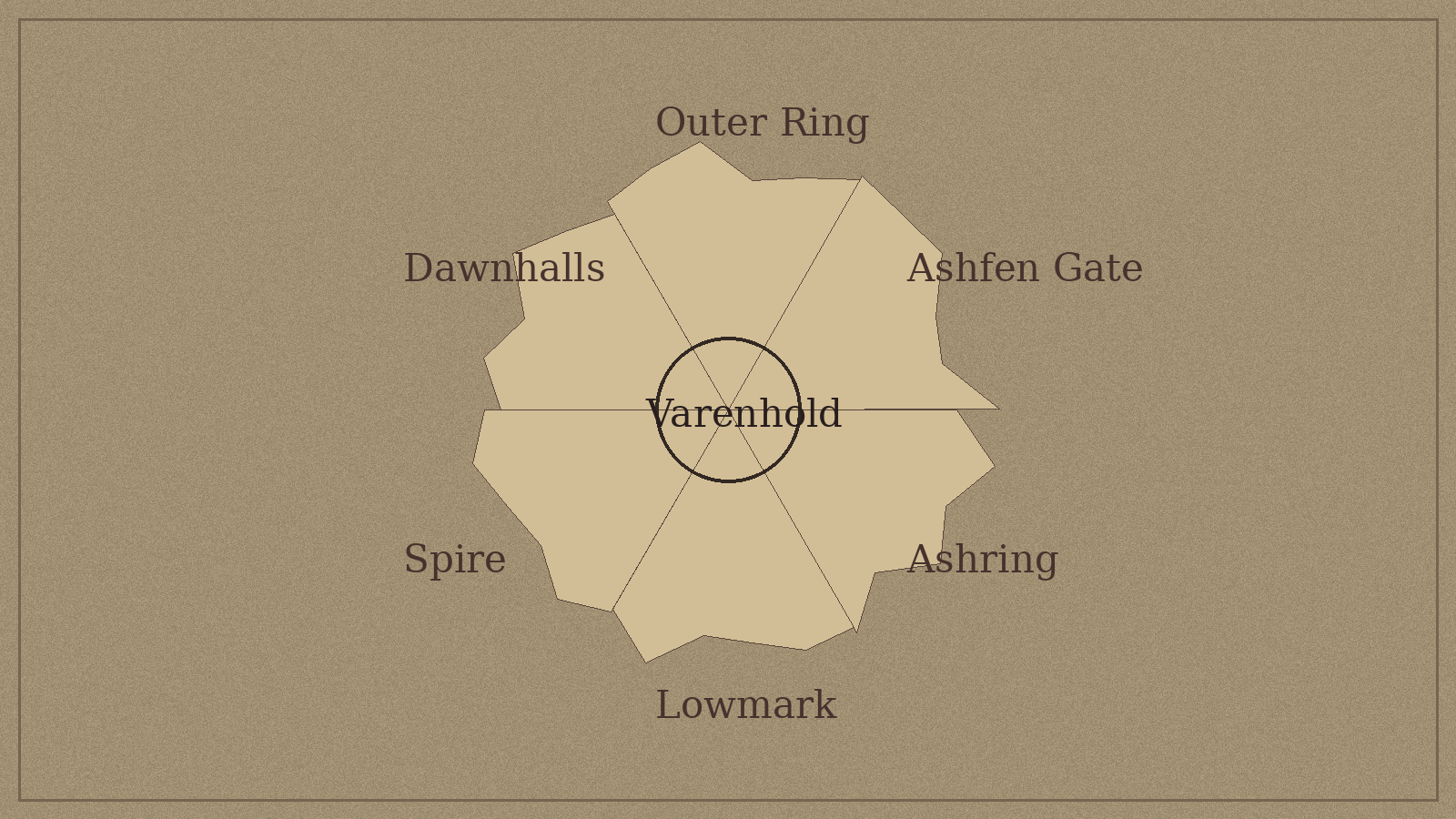
| The Ashring | The old city center, built around the great ceremonial plaza where the failed ritual took place. The stones of the plaza are scorched in a pattern that has never faded. |
| The Lowmark | Working-class district, most food production, most grey sickness. The Desperate are strongest here. |
| The Spire Quarter | Mages, scholars, the Archivist’s tower. Lanternlit streets. Pretends nothing is wrong. |
| The Dawnhalls | Barracks and communal residences where most of the Dawnborn live and train. Built by the city as a symbolic gift 30 years ago. |
| The Outer Ring | Merchant districts, temples (including the divided Auris cathedral), the Chancellor’s Hall. |
| The Ashfen Gate | Southern gate. Caravans enter here. The Restorers cult has a compound in the buildings adjacent. |
7.2 Districts of Varenhold
Detailed entries for each district. Use these for scene-setting, random encounters, and atmosphere.
7.2.1 The Ashring Quarter

Audio tour:
What it looks like: The oldest part of the city, dense with pre-twilight stone buildings whose upper stories lean toward each other across narrow streets. The Ashring plaza itself is open and striking - the scorch marks on the central stones form a rough circle approximately thirty feet in diameter, and no amount of cleaning, resanding, or resurfacing has ever made them fade. The stone is not burned - it is changed, at a molecular level the Spire scholars cannot fully explain.
What it smells and sounds like: Old stone dust, candle tallow, and the particular metallic smell that has clung to the plaza for fifty years - ozone-adjacent, as if lightning struck here recently and the air hasn’t recovered. The sound is crowd noise from the edges (the quarter is never quite empty) and the faint ring of the Ashring’s ceremonial bell, which tolls twice daily by tradition.
Key Locations: - The Ashring Plaza - The ritual site. Open to the public. Children play here. The Primer Stones ring the outer edge. Edoran sometimes comes here to sit. - The Archive of the Ashring - Not Theron’s main Archive; a secondary collection of city-founding documents, pre-ritual era maps, and the official (incomplete) account of the ritual’s failure. Public access. Curated by a junior archivist named Meva who knows more than she lets on. - The Watcher’s Hall - A tavern that has occupied the Ashring quarter since before the twilight. The current proprietor is a woman named Dorth who was four years old the night the sun vanished and remembers watching the ritual from her father’s shoulders.
Daily Life: The Ashring quarter is quieter than it was, but still inhabited - a mix of longtime residents who remember the pre-twilight era and younger people drawn to the historical weight of the site. It is not fashionable. It is meaningful in a way that’s hard to explain to newcomers.
District d6 Encounter Table:
| d6 | Encounter |
|---|---|
| 1 | A tourist from Solenne is photographing the scorch marks with scholarly intensity. They have entirely wrong theories and will share them at length. |
| 2 | Meva from the secondary Archive is locking up. She drops a bundle of papers. One is a pre-twilight drawing of the plaza with the ritual circle drawn in red. It looks exactly like the scorch marks. |
| 3 | Three children are daring each other to stand inside the scorch circle. One of them is Mira - Lira’s daughter - though the players won’t know this unless they know Lira well. |
| 4 | Edoran is sitting at the edge of the plaza, alone, watching the center. He has been there for two hours. |
| 5 | The Ashring bell tolls at the wrong time. No one can explain why. The sound lingers longer than it should. |
| 6 | A street musician is playing a lanternhalt in the plaza. By the fourth repetition, a small crowd has gathered and some of them are crying quietly. No one interrupts him. |
District Hook: Meva the junior archivist has been cross-referencing the official record against a private account she found misfiled. The private account - written by a midwife who delivered three of the Dawnborn that night - contradicts the official record on two key points: the births happened before the ritual’s backlash, not after, and all three mothers said they heard the same word in the moment of birth. The word is not recorded. Meva doesn’t know what to do with this.
What you might see here: - A stonemason cleans the scorch stones twice a week — not restoring them, just keeping them from getting worse. She can’t explain why she feels responsible. - A group of children taking turns standing in the center of the scorch circle with their eyes closed. “I’m trying to feel it,” one says. Neither they nor anyone nearby knows exactly what they’re trying to feel. - Two Auris priests — one Penitent, one Wounded — arguing quietly on the plaza steps. They are clearly old friends. They are clearly not going to agree. - A traveling artist sketching the scorch pattern for a Compact commission. “The most important thing that happened in the last hundred years,” they said. She doesn’t seem certain they’re right. - A child asking their parent what the marks are. The parent explains the ritual. The child asks: “Did anyone get hurt?” The pause before the answer is visible from thirty feet away.
Skill Checks: The Ashring Quarter
History (proficient)
The Ashring Quarter is the oldest part of Varenhold, built around the plaza where the Ritual of Eternal Dawn was performed fifty years ago. The scorch marks on the central stones have never faded despite repeated attempts to clean or resurface them. The secondary Archive in the quarter holds the official city account of the ritual’s failure, which is public and is known to be incomplete.
Arcana (proficient)
The scorch marks on the Ashring plaza are not the product of heat. The stone is changed at a fundamental level, recognisable to anyone with magical training as residual transformation rather than combustion. Something permanently altered the material structure here. The fact that fifty years of study has not explained it suggests the mechanism falls outside standard arcane frameworks.
Investigation (DC 13, at the secondary Archive)
The official account of the ritual’s failure contradicts three contemporary witness statements also held in the Archive. The contradictions are small but specific: the sequence of the backlash, and which primer stones activated last. The original ink is detectably different from a later correction. Someone edited the official account after the fact.
7.2.2 The Lowmark
Audio tour:
What it looks like: The Lowmark runs along the city’s river-facing edge, lower in elevation than the rest of Varenhold (hence the name) and subject to the cold, damp air that rolls off the Graymere River before dawn - or what would be before dawn if there were a dawn. Buildings here are older and more crowded than in other districts, with washing lines strung between upper stories and small market stalls occupying every available ground-floor space. The Dawnhall at the center of the district is the largest in the city.
What it smells and sounds like: Lowmark Stew from a dozen directions - the specific smell of long-simmered preserved vegetables and Ashfen marsh oil is Varenhold’s most recognizable scent. River damp. Woodsmoke from the Dawnhall hearths. Noise: children, market vendors, the distant sound of dock work. More coughing than anywhere else in the city - grey sickness is concentrated here.
Key Locations: - The Lowmark Dawnhall - The largest communal building in the district; runs a food kitchen, a care room, a small library of practical manuals, and a weekly assembly where the district’s concerns are aired. Administered by a volunteer council; the current head is Orya Doss (one of the Dawnborn), who does the work competently and without the expectation of recognition. - The Lowmark Healing House - Where Lira Anwick works mornings. Smells of dried herbs, stone, and something faintly sweet that might be the treatment compound she developed for early-stage grey sickness. Always busy. Minimal lighting (conserving lamp oil). The patients here are the most visibly suffering people in the city. - The Grain Measure - The district’s largest food distribution point, run by a man named Wess who has been tracking the city’s food supply with handwritten ledgers for fifteen years. His records are meticulous and alarming. The most recent entries show a 40% decline from five years ago.
Daily Life: The Lowmark is where the city’s survival infrastructure lives. People here work the docks, the gardens, the workshops, the Dawnhall kitchens. They are the most aware of the city’s actual state - not the political framing, but the food numbers. The grey sickness makes visible what elsewhere is kept quiet.
District d6 Encounter Table:
| d6 | Encounter |
|---|---|
| 1 | A woman is sitting outside the Healing House, not sick - waiting for a friend inside. She has been waiting for six hours. She offers to share her Lowmark Stew. It is very good. |
| 2 | The Grain Measure is locked. A hand-written sign says “inventory - back tomorrow.” A queue has formed. The people in it are quiet in a specific way that is worse than noise. |
| 3 | Wess is loading ledger books onto a cart. He is moving them somewhere safe. He will not say why, but his expression says he thinks things are about to get worse. |
| 4 | The grey sickness: a man in the street has stopped. Not fallen - just stopped walking, standing still, staring at the middle distance. His neighbor is gently trying to get him moving. |
| 5 | A Desperate pamphlet is being circulated. It does not say anything untrue. The players have to decide what that means. |
| 6 | Orya Doss is doing a Dawnhall supply run - she’s carrying an unreasonable amount of preserved goods in a pack and looking calm. If the players offer to help, she accepts without ceremony and tells them everything she knows about the district’s situation. |
District Hook: Wess’s fifteen-year food ledgers contain an anomaly: a three-year period roughly a decade ago when the food supply briefly stabilized, even slightly improved. The cause was never identified. The stabilization ended abruptly. No one has investigated. If the players do: the period corresponds to when three of the ensemble Dawnborn (Davin, Nin, and Cormac) were spending regular time in the Lowmark Dawnhall. Their presence - their Lux Anchor energy, ambient and uncontrolled - was slightly improving crop growth in the surrounding gardens.
What you might see here: - A healer from the Guild doing a free street consultation because the person couldn’t make it to the care house. Other people watch respectfully from a few feet away. One of them is also ill. She doesn’t approach. - A woman selling homemade “treatment compound” from a cart. The compound is marsh herbs and wishful thinking. A Guild practitioner watches from across the street, deciding whether to intervene. - Children playing a game where one is Sera (protecting the others), one is Tomas (settling disputes about the rules), and one is Lira (telling anyone who gets “hurt” that they’ll be okay). - The Grain Measure’s evening ledger posted publicly by Dawnhall tradition. A small crowd reads it. The numbers are worse than last month. Three people in the crowd understand exactly what this means. - Cormac Drell supervising an unloading at the docks — visibly stronger and faster than the dock workers, apparently unaware of the gap. He treats helping when a crate slips as unremarkable.
Skill Checks: The Lowmark
Medicine (proficient)
Grey sickness is visibly concentrated in the Lowmark. Stage 1 symptoms (pallor, persistent fatigue, slow healing) are present in a significant portion of the adult population. Stage 2 (loss of coordination, pronounced anaemia, difficulty with sustained physical exertion) is visible in roughly one in six. The Healers’ Guild care house here is the largest medical facility in the city and runs at permanent capacity.
Insight (proficient)
Lowmark residents have a specific relationship to outside help that newcomers often misread. They are not hostile to assistance; they are experienced with assistance attached to agendas. The difference between someone who comes to help and someone who comes to be seen helping is immediately apparent to anyone who has lived here for more than a season.
Investigation (DC 12, Grain Measure records)
Wess keeps fifteen years of food supply ledgers, posted publicly each evening by Dawnhall tradition. Reading them against each other reveals a three-year stabilisation period about a decade ago that was never explained and never repeated. The period ended abruptly. The records do not say why.
7.2.3 The Spire Quarter

Audio tour:
What it looks like: The Spire itself is a tower complex three hundred years old, built in the Reaches’ characteristic grey-blue stone but encrusted with decades of magical additions: extra floors bolted onto the exterior, bridges connecting wings that were clearly built separately, glass panels that glow faintly in colors that shift between amber and pale blue depending on the research happening inside. The surrounding quarter is Varenhold’s cleanest district - not prosperous, exactly, but maintained. Scholars care about their environment.
What it smells and sounds like: Chalk dust and the particular slightly-acrid smell of active magical reagents. Quill on parchment from open windows. More lamp oil than anywhere else (scholars work through all hours). The Spire Quarter has its own internal bell system for marking work shifts, which operates on a schedule that makes no sense to anyone outside the institution.
Key Locations: - The Civic Repository (Archive) - Theron Waide’s domain: twelve floors of documents, maps, and legal records going back to the city’s founding. The public floors are browsable by anyone. The restricted collection requires Theron’s personal authorization. The second subbasement contains the ritual documents and has not been opened to anyone but Theron in eleven years. - The Theoretical Division - The floor of the Spire dedicated to the twilight problem. Currently headed by Warden Keseph. Contains three competing research teams who share space, equipment, and mutual professional contempt. Also contains Isolde Menth’s laboratory in a side room that Keseph has been trying to reassign for two years. - The Scholar’s Rest - A tavern (technically a “collegial establishment”) that serves the Quarter’s inhabitants. Expensive by Lowmark standards, cheap by Spire standards. The best place in the city to hear academic gossip.
Daily Life: The Spire Quarter is a bubble. The people who live and work here have spent fifty years studying a problem they cannot solve, which produces a particular combination of exhaustion, defensiveness, and the quietly desperate hope that the next approach will be the right one. They are useful to the players and frustrating to interact with.
District d6 Encounter Table:
| d6 | Encounter |
|---|---|
| 1 | Two junior scholars are arguing in the street about a theoretical point. The argument is technically about ritual mechanics. It is actually about who gets the larger office when Keseph retires. |
| 2 | Isolde Menth is leaving the Spire at an unusual hour, carrying a leather satchel that is clearly heavier than she expected. She is heading toward the Cathedral. |
| 3 | A Spire messenger is distributing a pamphlet: the Theoretical Division’s official position on the ritual is that completion is possible in principle but not via current proposed methods. It is dense with qualifications. Warden Keseph’s name is prominently signed. |
| 4 | Theron Waide is in the Archive public section, reshelving documents. He is doing it wrong - the books are going back in approximately the right places but in the wrong order. He seems distracted. |
| 5 | A group of Arveth Compact scholars are visiting for an academic exchange. They are polite, well-funded, and asking questions that are slightly too specific about the ritual’s remaining documentation. |
| 6 | The Spire’s magical monitoring array (which tracks ambient energy levels in the city) has produced an anomalous reading. A junior scholar is posting a notice about it on the Archive door. The reading corresponds to the Ashring. The date is today. |
District Hook: The Spire has been monitoring the Dawnborn’s energy levels (passively, without their knowledge or consent) for thirty years using a long-range resonance tracker. The records show that Dawnborn energy depletion has accelerated in the last two years - by approximately 300%. This is not being reported to the Council. Keseph suppressed it because it undermines his research timeline. A junior scholar named Maret knows about the suppression and is looking for someone trustworthy to give the records to.
What you might see here: - A junior scholar conducting an outdoor experiment involving a lux-measurement device and amber plates. She looks frustrated — the device isn’t producing expected results. She’ll explain at length to anyone who asks, and is visibly relieved to have someone to explain it to. - Two scholars debating loudly in the reading room about the twilight’s mechanism. One says it’s a sympathetic void. The other says it’s a direct inversion. They are both partially right. Neither knows this. - A graduate student noting that Isolde Menth’s light has been on late three weeks in a row. She only does this when she’s close to something. - A former Spire student waiting to see if her old thesis advisor will meet with her. The advisor left two years ago. Nobody has told her yet. - The weekly faculty coffee hour audible from the hallway — a heated argument about whether the Compact’s research funding creates an obligation to share results. The underlying argument is about something else entirely.
Skill Checks: The Spire Quarter
History (proficient)
The Spire is Varenhold’s scholarly center, a three-hundred-year-old tower complex that has been studying the twilight problem for fifty years without producing a solution. This is known throughout the Reaches. The institution’s academic reputation has suffered accordingly. The Archive attached to the Spire is the largest document collection in the region; its public floors are open to anyone.
Arcana (proficient)
The Theoretical Division of the Spire currently maintains three competing research teams working on the twilight problem. They share space and equipment. Their theoretical frameworks are incompatible. This is not unusual in academic magical research; it is unusual that none of the three frameworks has produced a practical result in fifty years of active investigation.
Investigation (DC 14, Spire public records)
The Spire’s published research output on the twilight dropped sharply about twelve years ago. Papers from before that point show genuine methodological diversity. Papers after show a consistent narrowing toward a single theoretical position: Warden Keseph’s. Other approaches are present in the literature but receive no institutional resources. The shift is visible in publication funding records, which are part of the public archive.
7.2.4 The Dawnhalls District
Audio tour:
What it looks like: The Dawnhalls district is the city’s social center - the area built up around the original Dawnhall complex, which was constructed in the first decade of the twilight as emergency communal infrastructure and has been expanding ever since. The buildings are newer than most of Varenhold - built over the past forty years in the twilight era’s characteristic heavy-timber style, warm-toned wood and covered walkways. The Dawnhalls themselves are long, low, well-lit (this district uses more lamp oil than any other, by deliberate choice).
What it smells and sounds like: Food - more consistently than anywhere else in the city, the Dawnhalls smell of cooking, of warm broth and lamp oil and wood. Sound: conversation, children, the specific sound of a working communal kitchen. This is the only district in Varenhold where laughing is common enough to be unremarkable.
Key Locations: - The Great Dawnhall - The central communal building, which operates an open kitchen (free meals twice daily), a medical station, a meeting hall used for civic assemblies, and a small memorial space where photographs and objects belonging to people who have died of grey sickness are kept. The memorial is kept by an old woman named Nessa who has been maintaining it for thirty years. - The Dawnborn Residence - A building specifically provided for the Dawnborn fifty years ago, which most of them use as a base even though several live elsewhere now. Sera keeps her gear there. Tomas holds his judge’s consultations from a ground-floor room. Lira uses a back room for confidential patient follow-ups. - The Lantern Workshop - One of the amber workshop’s largest production facilities; the glow from the workshop windows is the brightest light in the district and serves as an informal landmark.
Daily Life: The Dawnhalls district is the most functional place in Varenhold. It is not the wealthiest or the most powerful, but it is the most organized - the Dawnhall system of communal support has kept the city from the worst outcomes of the twilight, and the people who run it are competent, exhausted, and proud. The Dawnborn are a visible presence here; their role is as much civic worker as symbol.
District d6 Encounter Table:
| d6 | Encounter |
|---|---|
| 1 | A child is sitting on the steps of the Great Dawnhall with a bowl of stew, watching the street. She asks the players if they know any Dawnborn. She has strong opinions about all of them. |
| 2 | Sera Voss is doing a walkthrough of the district in her off-hours - not as a guard, just as someone who wants to know how things are. She is easy to approach. |
| 3 | The memorial room in the Great Dawnhall is being visited by a family. Nessa is showing them the entry for their mother. The family is from the Dusk Parishes - they came specifically for this. |
| 4 | The Great Dawnhall kitchen is short on marsh oil today. A cook is asking around the district. This is unusual - the oil supply has been reliable for years. |
| 5 | Tomas Areth is finishing a consultation in his ground-floor room. The person leaving looks shaken. Tomas is folding a document carefully. He nods at the players without explaining. |
| 6 | The Lantern Workshop is having a shift change. The outgoing workers are singing - a lantern-carrier’s song, rhythmic, worn smooth by repetition. The incoming workers join halfway through. |
District Hook: The memorial room contains a photograph of a woman who died of grey sickness four years ago. Her name is Annem Edoran. Brother Edoran has never visited the memorial. Players who discover the connection and bring it to him carefully may unlock a significant shift in his attitude.
What you might see here: - The morning meal being served. The queue is longer than yesterday. The kitchen manager is quietly counting portions and doing math she doesn’t like the answer to. - Sera Voss eating breakfast in the public hall — not a separate room, just sitting with people. A child has come to sit next to her and is explaining their week. She’s listening with her whole body. - A notice posted about the food stores: 37%, down from 40% last week. Someone wrote in small letters at the bottom: “This is not fine.” The note has not been taken down. - Neighbors doing maintenance on a shared building. Not organized, no meeting called — they just showed up because the window needed fixing. This is how most Dawnhall maintenance gets done. - Lira passing through on her way to the care houses, tired in the way of someone always tired. A neighbor stops her to ask about her daughter; the warmth that crosses her face for about three seconds before she answers is genuinely arresting.
Skill Checks: The Dawnhalls District
History (proficient)
The Dawnhalls system was built in the first decade of the twilight as emergency communal infrastructure. The Great Dawnhall in this district is the largest of twelve such buildings across Varenhold, providing free meals twice daily, medical support, and civic meeting space. The name comes from the timing of their founding and the Dawnborn’s role in their early establishment.
Insight (proficient)
The Dawnhalls run on volunteers and goodwill, but they are not disorganized. The people running them have been doing so for decades and have a specific way of identifying who is here to help and who is here for other reasons. Genuine presence earns genuine welcome; performance earns polite distance.
Perception (DC 11, at the Great Dawnhall memorial room)
The memorial room holds photographs and objects belonging to people who died of grey sickness. It is maintained carefully. One entry, dated approximately six years ago, shows a young woman around seventeen years old. The family name on the entry is Edoran.
7.2.5 The Outer Ring
Audio tour:
What it looks like: The Outer Ring is the city’s former prestige district - the arc of wide streets and grand buildings that was developed during Varenhold’s golden age to house the merchant guilds, the major temples, the Chancellor’s Hall, and the homes of the wealthy. It is still the most architecturally impressive district, but the grandeur is fraying. Several of the merchant guild halls are operating at reduced capacity or leased to secondary purposes. The Auris Cathedral is the largest building in the city and is visibly divided - one half maintained by the Penitents (clean, draped in mourning cloth), one half maintained by the Wounded faction (actively decorated, flowers on the altar, arguing with the Penitents in the forecourt).
What it smells and sounds like: Less lamp oil here - the Outer Ring burns beeswax candles, more expensive, maintained as a status signal. Perfume and stone. The sound of merchant negotiation from the Compact offices and, emanating from the Cathedral, the sound of two choirs singing different hymns.
Key Locations: - The Chancellor’s Hall - Varenhold’s seat of government: a large, formally maintained building that has seen more use in the last three years than in the previous fifteen combined. The Council chamber is on the second floor. The Chancellor’s private office faces the street, and her lamp is always lit. - The Auris Cathedral - The divided cathedral: the Penitent nave (northern) and the Wounded nave (southern) share a single building separated by a temporary wall erected twelve years ago. The wall has become permanent. Each side conducts separate services. They occasionally attempt formal dialogue. It rarely goes well. - The Merchants’ Compact Office - The surviving merchant consortium’s headquarters. Run by a woman named Saret Onn who has been maintaining Varenhold’s remaining trade relationships through sheer organizational competence and extensive personal correspondence. The office receives dispatches from five regional partners daily.
Daily Life: The Outer Ring is where power is performed. People who work here are aware of status in a way that the rest of the city, too exhausted to maintain the performance, has largely set aside. The Outer Ring still has dress codes. It still has protocols. It still has the politely maintained fiction that Varenhold is a functioning major power, not an aid recipient.
District d6 Encounter Table:
| d6 | Encounter |
|---|---|
| 1 | The two Cathedral choirs are competing at the same time. The sound is extraordinary - not pleasant, but striking. Passersby have stopped in the street. Neither choir will stop first. |
| 2 | A Council courier is moving between buildings very quickly. If the players follow or intercept: they’re carrying the Chancellor’s latest correspondence from Solenne. The letter’s seal has been broken and re-pressed. |
| 3 | Saret Onn is in the street doing a supply count with a junior factor. She is displeased with what she’s finding. She is not the kind of person to panic, which makes her displeasure more alarming. |
| 4 | A Restorer pamphlet has been nailed to the door of the Chancellor’s Hall. The guard on duty is uncertain whether to remove it without orders. |
| 5 | A merchant from the Arveth Compact is leaving the Compact Office with a smile. He has just gotten a favorable contract. The terms are not good for Varenhold. Saret watches him go without expression. |
| 6 | The Penitent and Wounded choir leaders are meeting in the Cathedral forecourt, ostensibly for a scheduled dialogue. It is going badly. Each believes the other faction’s theology is actively harmful. Both are partially right. |
District Hook: The temporary wall dividing the Cathedral was built over the original altar - which is also, according to Corven’s original ritual documents, one of the three backup resonance nodes for the ritual. The inversion pathway can technically be triggered from the Cathedral as a secondary site if the Ashring is somehow unavailable. This has not been discovered because the wall built over the altar has been there for twelve years. The Wounded faction’s head priest knows something is under the wall. He has not told the Penitents. He has been waiting for a reason to open it.
What you might see here: - The two Cathedral choirs competing simultaneously. The sound is extraordinary — not pleasant, but striking. Passersby have stopped in the street. Neither choir will stop first. - A street performer playing a lanternhalt ballad in the Highmark arcade. Small audience. The unresolved final chord lands and nobody moves for a long moment afterward. - A nobleman who left Varenhold fifteen years ago walking through the Highmark comparing what he sees to his memory. He keeps stopping at things that no longer match. He isn’t distressed — he’s genuinely curious. - The Council Registrar’s queue: a grey sickness patient needing care house priority, a merchant with a Compact dispute, and a third person who has been waiting three months for a different matter and is here again. - The Chancellor’s window is lit early. A citizen who passes it every morning has developed a superstition: if it’s lit before the first bell, it’s a difficult day. He’s been right more often than chance.
Skill Checks: The Outer Ring
History (proficient)
The Outer Ring is Varenhold’s former prestige district, built during the city’s pre-twilight height to house the merchant guilds, major temples, and the Chancellor’s Hall. The architecture is grander than the rest of the city but visibly strained; several guild halls are operating at reduced capacity. The Auris Cathedral, the largest building in the city, is divided between two factions who share the building but not its theology.
Religion (proficient)
The Auris Cathedral division is formal and permanent. The Penitent faction controls the northern nave; the Wounded faction controls the southern. A wall separating them was installed twelve years ago and has not come down. Both factions conduct separate services, maintain separate clergy, and occasionally attempt formal dialogue. The forecourt is shared. The dialogue rarely goes well.
Insight (DC 12, at the Chancellor’s Hall)
The Chancellor’s Hall is in continuous use at hours that suggest urgency. Staff move between departments with documents that do not pass through the normal registry. The public-facing pace of the Council does not match the private pace of the people running it.
7.2.6 The Ashfen Gate District
Audio tour:
What it looks like: The southernmost district, named for the gate that opens toward the Ashfen marshes and the trade roads beyond. This is the entrance district - where caravans arrive, where travelers stay, where the city shows its face to outsiders. The Wayshrine of the Wanderer stands just outside the gate, maintained by the city regardless of religious affiliation. Inside the gate, the streets are slightly wider (designed for cart traffic) and the buildings are predominantly inns, stables, storage houses, and the Restorer compound, which occupies what was formerly a trading post.
What it smells and sounds like: Animal, hay, the cold air blowing in from the Ashfen marshes - the distinctive marsh smell of wet vegetation and Ashfen oil is strongest here, carried by the south wind. Trade sounds: loading and unloading, the creak of wagon wheels, the particular cadence of negotiation at the customs station.
Key Locations: - The Ashfen Gate - The gate itself: two large wooden doors reinforced with iron, maintained carefully because they are the city’s most-used entrance. Guards here are more worldly than most Varenhold guards; they have seen travelers from every part of the Reaches. - The Restorer Compound - The former Ashfen Trading Post, now the Restorers’ primary meeting space, dormitory, and organizational center. Open to the public for services. Closed areas include Edoran’s private office (where the ritual documentation analysis is kept) and the cells for Restorers in emotional crisis. - The Wayfarer’s Rest - The best inn in the district, run by a former Compact merchant named Helka who left trade twenty years ago and settled in Varenhold permanently. Her inn’s guest book contains entries from travelers across the Reaches over twenty years; she can tell the players anything they want to know about traffic in and out of the city.
Daily Life: The Ashfen Gate district is the most transient part of Varenhold - people are always arriving and leaving, which makes it the most information-rich district and the most emotionally variable. On a good day, a caravan arrives with news, goods, and outside perspective. On a bad day, a caravan departs and doesn’t come back, and everyone in the district watches the gate stay closed.
District d6 Encounter Table:
| d6 | Encounter |
|---|---|
| 1 | A caravan from the Dusk Parishes is being unloaded. The Parish delegates are arguing with the customs official about a discrepancy in the paperwork. One crate is mislabeled. It contains Restorer pamphlets. |
| 2 | Helka is reviewing her guest book with a specific expression - she has found something. She won’t say what unless the players have previously given her reason to trust them. |
| 3 | A Restorer service is in progress in the compound’s public hall. Fifteen people, mostly Lowmark residents. Edoran is not present - a younger priest is leading it. The theology is sharper, less nuanced, than Edoran’s. |
| 4 | A traveler from Solenne is at the gate having an argument with the guard. She wants to enter the city. The guard is uncertain - her papers describe her as a “Penitent observer.” The guard is not sure if that’s allowed. |
| 5 | Something has come through the gate that has the customs guards confused: a sealed official document from the Arveth Compact, addressed to Chancellor Ostenveld, marked “urgent” and “confidential.” The courier won’t explain its contents. |
| 6 | The Wanderer’s Wayshrine outside the gate has fresh offerings this morning - food, small coins, a child’s toy. Someone traveling in great need passed through the gate last night. The gate guard doesn’t know who. |
District Hook: Helka’s twenty-year guest book contains an entry from eleven years ago - the same year Theron Waide decoded the ritual’s cost. A traveler signed in under a false name (obvious, the handwriting is forced) and stayed two nights. Their notes in the margins of the guest page mention “documents transferred” and “Archive contact confirmed.” Helka has never investigated. The false name used is close to an Arveth Compact merchant family name.
What you might see here: - A caravan from the Dusk Parishes just arrived. The driver is carrying unofficial Parish correspondence alongside the official goods and is trying to find someone to take it without questions. - A pilgrim freshening the Wanderer’s Wayshrine just outside the gate. He ties a yellow cord to the railing — traveler’s courtesy, requesting safe passage. Several other cords are already there. - A group of Dusk Parish children at the gate for market day, looking at everything with enormous eyes. One walks to the edge of the amber lantern light and back again, testing where it ends. - An Ashfen Clan Wadewalker waiting for customs clearance on marsh herbs. While she waits she writes in a small notebook — documenting changes in the city’s ambient magical field. Her third visit this year. - More activity than usual at the Restorer compound. People coming and going, something being organized. A neighbor who has been watching the compound for years says this is new. She doesn’t know what changed.
Skill Checks: The Ashfen Gate District
History (proficient)
The Ashfen Gate is Varenhold’s main southern entrance, named for the marshes it faces. Caravans from the Dusk Parishes and the broader Reaches arrive here. The district is the most transient in the city: inns, stables, storage houses, and the Restorer compound, which occupies a former trading post. The Wayshrine of the Wanderer stands just outside the gate.
Nature (proficient)
The cold air blowing in from the Ashfen marshes is detectably different from the city’s usual air. Experienced travelers and naturalists can tell how recently the gate has been open and whether anything unusual came through by the quality of the marsh smell, a combination of wet vegetation and Ashfen oil that shifts noticeably with changes in traffic or weather.
Investigation (DC 13, at the Wayfarer’s Rest)
Helka’s guest book covers twenty years of arrivals. Reading it as a document rather than a register, looking at patterns rather than individual entries, shows something: the rate of travelers arriving without a stated destination has increased steadily over the past four years. More people are arriving in Varenhold without saying where they came from or why.
7.3 History: The Night the Sun Died
7.3.1 Before the Twilight
Fifty years ago, Varenhold was at its height. The city’s ruling Council had hired a cadre of the most powerful mages in three kingdoms to perform the Ritual of Eternal Dawn - an amplification of the sun’s blessing meant to ensure Varenhold’s crops would never fail and its people would never suffer the harsh winters of the surrounding regions.
The ritual was years in preparation. It was publicly celebrated. Children were kept awake to watch. Merchants bet on it succeeding.
7.3.2 The Night It Failed
The ritual did not simply fail to work. It inverted. The exact mechanism is lost - the lead mage, Archmagister Corven, died in the backlash, and most of his notes were destroyed. What remained was this: the sun’s light, which should have been amplified, was instead severed from the city. Dawn came everywhere else in the world. In Varenhold, the horizon simply… stayed.
Ten children were born that night - premature births triggered by the magical shockwave, or so the midwives said. All survived. All were touched by something.
The Dawnborn.
7.3.3 The Dawnborn: Born in the Gap
The ten children born in the wake of the ritual grew up differently. Not dramatically, not visibly - but differently. They were stronger than average. They healed faster. They could sense danger before it arrived, and they were unusually difficult to deceive. More than that: they were compelling. When they spoke, people listened. When they acted, others followed.
As adults, they became what Varenhold needed: guards, healers, scouts, negotiators, a judge. The city did not officially grant them special status, but everyone understood that the Dawnborn were special. They are famous within Varenhold. Beloved. Trusted.
No one, until very recently, understood why they were the way they were.
7.4 The Ritual’s True Cost
Don’t share this with players until Session 2.
The Ritual of Eternal Dawn did not fail in the ordinary sense. It succeeded - and then broke. The sun’s light reached Varenhold, amplified, and then the anchor point of the ritual - a living conduit, never intended to survive - burned out.
The ten Dawnborn are that conduit’s legacy. They are, in the language of the original ritual texts, Lux Anchors - living batteries for the compressed solar energy that should have been released. The energy that was meant to light the city permanently is inside them, distributed across all ten, slowly being consumed by their extraordinary abilities.
When all ten Lux Anchors are extinguished simultaneously at the site of the original ritual, the stored energy is released. The sun returns.
The Archivist has known this for eleven years. He has told no one.
7.5 The Ritual in Detail
The full picture — what actually happened, what the ritual actually does, and how to run the Sessions 4-5 ritual scenes accurately.
7.5.1 What Corven Believed He Was Building
Archmagister Varen Corven was not a reckless man. He spent eleven years designing the Ritual of Eternal Dawn, commissioned by the City Council to address Varenhold’s periodic winter-light shortages. His design was sound - in concept.
Corven’s framework was solar amplification and anchored storage: capture excess solar energy during peak summer months, store it in a permanent living-resonance anchor (an object imbued with life-force that would slowly release the stored energy), and draw from that reserve during the dark months. He modeled it on existing preservation rituals used in Arveth Compact food storage.
His critical error was in the definition of “living anchor.” In food preservation ritual, “living resonance” refers to a material property - the organic quality of grain, fruit, salted fish. Corven extrapolated this to solar magic and concluded that a sufficiently powerful life-resonance anchor would be an organic object imbued with amplified vitality.
What he actually built was a conduit that required human birth-resonance. The ritual’s peak energy moment coincided with new births in the city. The ten premature births triggered by the ritual’s magical shockwave bonded with the energy at the moment of first breath - the strongest life-resonance event there is. The children became the anchors.
Corven discovered this in the six minutes between the ritual’s catastrophic inversion and his death. He spent those six minutes writing a letter to be found later. (See Session 5, Corven’s Final Entry.)
7.5.2 The Twelve Steps of the Ritual
Corven’s ritual proceeded in twelve stages, each requiring specific materials, positions, and timing. Reconstructing this sequence is the work of Sessions 2-3 (the Archive, the Cathedral diagrams, Isolde’s laboratory). The full sequence, for GM reference:
| Step | Ritual Stage | What It Was Meant to Do | What Actually Happened |
|---|---|---|---|
| 1 | The Preparation Circle | Mark the Ashring in resonance-chalk; establish the ritual boundary | Completed correctly; marks still visible in scorched stone |
| 2 | The Solar Binding | Three senior mages establish a sympathetic link to the sun’s light | Completed correctly; this is why dawn still exists elsewhere |
| 3 | The Amplitude Array | Twelve junior mages amplify the binding to city-scale | Completed correctly; this is why the energy entered Varenhold at all |
| 4 | The Living Anchor Invocation | Call the anchor material into the circle; Corven intended an organic object | The city’s life-resonance responded instead; birth-energy from ten premature labors pulled into the circle |
| 5 | The Compression Phase | Compress the amplified solar energy into the anchor | Compressed correctly; this is why the Dawnborn are extraordinary |
| 6 | The Distribution Lattice | Spread compressed energy across the anchor for even release | Distributed across all ten births instead of one object; the “surge phase” difference (five stronger anchors per Tomas’s math) |
| 7 | The Release Calibration | Set the anchor to release energy at a measured rate | Failed - the living anchors resisted calibration instinctively (infants responding to magical trauma) |
| 8 | The Stabilization | Lock the release rate in place | Failed; without calibration, the release locked at zero - energy sealed inside the anchors |
| 9 | The Backlash | Not a planned step - the ritual’s energy inverted when stabilization failed | Killed Corven; injured three other mages; destroyed most of the ritual documentation |
| 10 | The Suspension | Not planned - the severed solar link left the sky in permanent pre-dawn suspension | This is the twilight; the solar binding still exists but the amplified energy cannot reach the sky |
| 11 | The Slow Drain | Not planned - the Dawnborn’s extraordinary abilities slowly consume the sealed energy | This is why the Dawnborn are slowly aging normally despite their resilience; the energy is being used |
| 12 | The Release | Original: gradual energy release through the calibrated anchor. Actual: requires simultaneous extinguishing of all ten anchors at the Ashring | This is the cost the ritual’s true completion requires |
7.5.3 What the Inversion Actually Requires
Corven designed a failsafe into Steps 6 and 7: an inversion pathway that would allow the anchors to release their energy voluntarily rather than through extinguishing. He built it because he understood that any living-resonance anchor might develop independent will over time (he was thinking about objects, not people, but the principle held).
The inversion pathway requires:
- All ten Lux Anchors present at the Ashring - specifically at the ten Primer Stones Corven had inscribed as guidance markers
- Simultaneous willing activation - all ten must consent and initiate release at the same moment (within one round)
- The central inscription active - the Primer Stones must be in resonance sequence before the simultaneous activation; the inscription serves as the focusing lens
- No external magical interference - any disruptive spell cast within 30 feet of the circle during activation attempts to hijack the inversion pathway
If all four conditions are met: the energy releases upward, the solar binding completes, the sun rises. The Dawnborn survive, diminished - their extraordinary abilities fade over weeks as the stored energy disperses, but they live.
If even one anchor is absent or unwilling: the inversion pathway cannot complete. The ritual either fails (if fewer than five anchors are present) or defaults to the destructive completion path (if five or more anchors are present and the ritual energy builds past a threshold without inversion).
7.5.4 Partial Ritual Effects
This is what Tomas’s Asymmetry Journal was calculating, and what the Tier 3 diagram in the Cathedral revealed.
| Anchors Present and Willing | Ritual Result |
|---|---|
| 1-2 | Nothing. Insufficient energy to trigger any reaction. The stones pulse briefly. |
| 3-4 | The twilight brightens slightly (from Session 1-2 resting state). Temporary. Fades within weeks. No change to grey sickness rates. |
| 5 (standard) | Measurable brightening; crops improve marginally; grey sickness slows. Not a solution. Repeating this requires 5 more willing Dawnborn - a diminishing resource. |
| 5 (surge-phase anchors) | Better brightening; crops improve significantly; grey sickness halts. Still not a solution. The remaining 5 Dawnborn lose their surge-phase advantage if the 5 have contributed. |
| 6-9 | Substantial improvement approaching pre-twilight conditions. The sun does not rise, but the sky is warm enough to approximate it. Some crops fail to notice the difference. |
| 10 (all, destructive path) | Sun rises. All ten Dawnborn die. The process takes approximately three minutes. It does not appear painful from the outside. |
| 10 (all, inversion path) | Sun rises. All ten Dawnborn survive. The process takes approximately thirty seconds. The Dawnborn describe it afterward as “letting something go.” |
7.5.5 The Lux Anchor Science
The Dawnborn’s extraordinary qualities are direct expressions of the sealed solar energy:
Physical strength and resilience - Compressed solar energy manifests as vitality amplification. The Dawnborn heal faster, tire slower, and are marginally harder to kill than equivalent non-Dawnborn humans. This advantage is slowly decreasing as they age and the energy depletes through use.
Danger-sense and awareness - The solar energy creates a faint sympathetic resonance with ambient light. The Dawnborn “feel” changes in the light field around them at a level below conscious perception - this reads as intuition and threat-detection.
Compelling presence and difficulty of deception - The most interesting effect. Solar energy in ritual contexts is associated with clarity and revelation. The Dawnborn’s stored energy creates a mild, involuntary field that makes falsehood slightly harder to sustain in their presence. Players trying to lie to a Dawnborn face Disadvantage on Deception checks (regardless of whether they know this).
The Lux Glow - Some Dawnborn, particularly those with higher residual energy, produce faint ambient light in low-light conditions. This is involuntary and they cannot suppress it. It intensifies when they are emotionally or physically under stress.
Rate of depletion - The energy is being consumed gradually through the Dawnborn’s enhanced abilities. At current rates, the stored energy would be fully depleted in approximately 80-100 years. This means the Dawnborn will likely die of natural causes before the energy is gone - the city’s problem will simply continue. The Restorers’ argument that the Dawnborn are “already dying” is therefore partially wrong: they will not die from the depletion in any timeframe that matters, but neither will the depletion solve the city’s problem.
7.5.6 What the Spire Has Tried in Fifty Years
Useful background if players ask Isolde or the Spire Scholars what’s been attempted.
| Approach | Attempted By | Why It Failed |
|---|---|---|
| Solar bridge reconstruction | Spire mages, Sessions 1-20 post-twilight | The solar binding from Step 2 still exists and cannot be duplicated; every attempt to establish a new binding is absorbed into the old one |
| Artificial sunlight cultivation | Amber Workshop Mages, ongoing | Works at close range; cannot be scaled to atmospheric level; the amber lanterns are the best result of this research |
| Ritual document reconstruction | Theron Waide (and predecessors), 40 years | Partially successful; Waide decoded the cost eleven years ago and stopped documenting |
| Lux Anchor energy siphoning | Isolde Menth, Sessions 1-20 post-her-arrival | Technically possible but requires Cathedral-scale architecture as the target reservoir; developed into the Session 3 alternative path |
| Partial ritual completion | Proposed by three separate scholars over fifty years | Rejected by the Council because it was understood to require Dawnborn deaths; the partial-without-deaths option from the inversion pathway was not discovered |
| Astronomical induction | Graymere Holds collaboration, failed expedition | The brief light moments at high altitude are a reflective phenomenon, not a source; cannot be amplified down to city level |
| Ashfen Clan Wadewalker methods | Informally consulted twice | Wadewalkers determined the problem is “upstream” - the ritual’s architecture is sound but the anchor is wrong; they could not recommend a fix within their framework |
| Divine intervention (Auris) | Penitent clergy, continuous | No verifiable response; Wounded faction’s counter-theory is that the god is present and waiting, not absent and punishing |
7.6 The Factions
7.6.1 The City Council
What they want: Stability. The illusion of competence. To not be blamed.
The Council is not corrupt so much as cowardly. They know the city is declining. They have spent fifty years trying incremental solutions - trade agreements, new strains of dim-tolerant crops, subsidized lamp oil - and each has worked just enough to delay the reckoning. The current Chancellor, Mira Ostenveld, is the first Council member in two decades to seriously investigate the ritual’s reversal. She has hired the players.
She has not told them everything she suspects.
Key attitude: The Council is sympathetic to players who are discreet and bring results. They turn hostile if the players create public instability, expose their complicity in covering up the ritual’s cost, or challenge their authority openly.
Named Council Members:
| Name | Position | Stance on Ritual |
|---|---|---|
| Chancellor Mira Ostenveld | Head of Council; executive authority | Pragmatist: wants a solution, prefers consent, willing to force if necessary |
| Councillor Davan Ashby | Commerce and trade; former merchant | Pure pragmatist: “restore the sun and the city survives, everything else is detail” |
| Councillor Preva Solm | Health and welfare; former healer | Moralist: adamant that Dawnborn lives cannot be sacrificed; has been arguing this for six years |
| Councillor Ren Holt | Civil order and guard | Pragmatist-adjacent: worried about Desperate and Reckoning more than the ritual; will vote for whatever ends the instability fastest |
| Councillor Maret Lonn | Education and archive oversight | Unknown quantity: former Spire Scholar, keeps her own counsel, the swing vote the players can influence |
How the Council Makes Decisions: Simple majority vote, with the Chancellor casting a tie-breaker. For the final ritual vote, a Council quorum is required (all 5 present). Players who build relationships with individual councillors can shift the vote - Preva Solm is the most moveable toward protecting the Dawnborn; Davan Ashby is the hardest to shift from pro-ritual.
Getting an Audience: Standard petitions go through the Chancellor’s aide (a harried young man named Torsten). Players who have earned trust can request direct meetings. Emergency access is available to players who can demonstrate immediate danger to the city.
7.6.2 The Dawnborn
What they want: To protect Varenhold. To live. To understand what they are.
The Dawnborn are not a formal faction - they’re ten individuals who share an origin and have become a symbol. They are not unified in how they feel about their situation. When the truth about the ritual comes out, they will splinter.
See NPCs for individual profiles. The three most prominent Dawnborn - Sera Voss, Tomas Areth, and Lira Anwick - are featured in every session.
Key attitude: Initially friendly and collegial. They are used to being trusted. When they learn the truth, their reactions diverge radically based on their characters.
Internal Dynamics:
The ten Dawnborn have known each other their entire lives and have a complex social web. Key relationships:
| Relationship | Details |
|---|---|
| Sera and Tomas | Old friends, mutual respect; they disagree about almost everything intellectually and trust each other completely |
| Lira and Ysel | Longest friendship among the ten; the rift when Ysel chooses to be willing is the emotional core of Sessions 4-5 |
| Davin and Aldric | The “older brothers” dynamic; Davin is calm and accepting, Aldric is angry and protective; they manage each other |
| Petra and Lira | Fractured friendship (argument three years ago); Petra’s anonymous support payments to Lira’s daughter are unacknowledged by both |
| Cormac and Nin | Unlikely friendship between the dock master and the reformed criminal; they drink together, they have each other’s backs |
| Tomas and Orya | Academic partnership; Orya’s cartography and Tomas’s records have been used together for years; she’s the first one he told about his suspicions |
Faction Session State Table:
| Session | Dawnborn Faction State |
|---|---|
| 1 | Unaware; open and trusting; players can build connections freely |
| 2 | Learning the rumor; some are hearing fragments; Tomas is putting things together |
| 3 | Aware of the basic truth; individual reactions beginning to diverge |
| 4 | Publicly split; The Willing/Unwilling/Undecided division is visible to the city |
| 5 | Each Dawnborn in their final position; no further movement without specific player action |
7.6.3 The Restorers
What they want: To restore the sun at any cost. They believe the Dawnborn are already dead - walking batteries slowly burning out - and that mercy demands releasing them sooner rather than letting them drain away.
The Restorers are not a death cult in the traditional sense. Their leader, Brother Edoran, is a former Auris priest who lost his daughter to grey sickness. He is not cruel. He has simply done the utilitarian math and arrived at a conclusion most people refuse to consider.
The cult has cells throughout the city, particularly in the Lowmark. Some members are grieving parents. Some are former farmers watching their land die. A few are fanatics who have convinced themselves that the Dawnborn secretly know and secretly consent.
Key attitude: Cautiously cooperative with players who seem to prioritize restoration. Hostile to players openly allied with the Dawnborn. Brother Edoran is willing to negotiate if approached in good faith.
Internal Factions:
| Faction | Leader | Position | Size |
|---|---|---|---|
| The Grieving | Edoran (de facto) | Restoration through consent; horrified by violence | ~60% of membership |
| The Idealists | Sister Mave, 40s, former teacher | Restoration is moral imperative; consent is ideal but not required | ~30% |
| The Fanatics | Jaret (from Session 1) | Immediate action, forced if necessary; Dawnborn have already consented implicitly | ~10% |
Edoran’s control problem: He can moderate the Grieving. He has partial influence over the Idealists. He cannot control the Fanatics, and they know it. If Edoran is arrested, compromised, or killed, the Fanatics take organizational leadership within 48 hours.
Membership: Joining the Restorers requires attending three public services and completing a private conversation with any senior member. The vetting is not rigorous - the Restorers are not primarily concerned about infiltration. They’re a grief movement, and grief is easy to fake credibly.
How to join as a player: Any player who attends services, expresses sympathy with the restoration goal (not necessarily the method), and passes a simple DC 12 Deception or DC 14 Persuasion check will be admitted within a week of in-game time.
Faction Session State Table:
| Session | Restorer State (if players ignore them) |
|---|---|
| 1 | Active but legal; pamphlets, services, petition to Council |
| 2 | Growing; Edoran has made contact with a willing Dawnborn (Ysel) privately |
| 3 | Tense; the Fanatics are pushing for action; Edoran is holding them |
| 4 | Fracturing; the Reckoning splinter has broken off; Edoran has lost control of the Fanatics |
| 5 | Remnant; Edoran’s core followers plus whatever Jaret’s group does independently |
7.6.4 The Desperate
What they want: Something to work. Anything.
The Desperate are not a formal faction - they are a movement. Working-class Varenholders who have watched the city decline for their entire lives. They have no ideology beyond urgency. Some have joined the Restorers. Some petition the Council. Some are beginning to look at the Dawnborn with something darker than admiration.
In Sessions 3-5, if the players have not addressed the Desperate’s concerns, they become a mob. They are not villains - they are desperate people who have run out of patience.
Key attitude: Initially neutral to players. Warm to players who visibly listen to them. A threat to anyone who seems to be stalling or protecting the status quo.
Named Leadership:
| Name | Role | Position |
|---|---|---|
| Senna Kard | Street organizer; Lowmark; rage engine | Legitimate grievances expressed through crowd violence |
| Brin Oss | Former dock worker; practical organizer | Wants results, not drama; the most reasonable voice in the movement |
| Pella Vain | Parish delegate to Varenhold | External voice; represents the Dusk Parishes’ dying farms |
Tipping Points: The Desperate escalate from petition to protest to violence on a specific trigger track. Knowing the triggers lets the players manage the escalation:
| Trigger | Effect |
|---|---|
| Another food rationing announcement | +1 pressure level |
| Public evidence that the Council knew and concealed the ritual cost | +2 pressure; immediate rally at Council Hall |
| Any Dawnborn visibly leaving the city | +1 pressure; perceived as abandonment |
| Players visibly listen to Senna or Brin; genuine engagement | -1 pressure |
| Partial ritual completion (brighter sky) | -2 pressure; buys significant time |
| Full ritual completion | Pressure resets; grief begins |
What they’ll accept as partial victory: Any credible sign of progress. The Desperate are not ideological - they want to see something working. A brightened sky, a verified alternative path, a credible public commitment from the Dawnborn - any of these reduces pressure significantly.
Faction Session State Table:
| Session | Desperate State (if players ignore them) |
|---|---|
| 1 | Simmering; petitions, quiet vigils |
| 2 | Vocal; public gathering at Lowmark Dawnhall; Senna’s first public speech |
| 3 | Active; street demonstrations; first minor violence |
| 4 | Crisis; mob stormed Council Hall; two injured; Council wants martial law authorization |
| 5 | Decisive; either behind the players’ solution or blocking it |
7.6.5 The Healers’ Guild
What they want: To treat people effectively, maintain professional neutrality, and survive the political situation without being forced to take a side.
The Healers’ Guild is one of the few institutions in Varenhold that all factions trust, because it has maintained strict neutrality for fifty years. The Guild treats Restorers, Desperate, Council members, and Dawnborn with equal professionalism. This makes it the city’s most reliable information network - Healers see everyone at their most vulnerable.
Guild Master: Sevra Dain (she/her), 58 years old, Lowmark-born, has been running the Guild for fifteen years. Dry sense of humor. Professionally calm. Quietly furious about the grey sickness rate and the political paralysis that has prevented addressing it. She will cooperate with players who are trying to improve the situation and will not help players who are making it worse.
What the Guild Knows (that no one else does): - The grey sickness rate by district, updated weekly - the Spire’s numbers are 15% lower than reality because they’re using outdated census data - Which Dawnborn have sought private medical consultations and why (confidential, but a player who earns significant trust may get partial disclosure) - That Lira Anwick has a child - Sevra delivered Mira and has kept the secret at Lira’s explicit request - The correlation between Dawnborn presence and reduced grey sickness rates in the areas where they spend time
Joining the Guild’s information network: Players who assist the Healing House (treating patients, securing supplies, protecting healers during unrest) can build enough trust for Sevra to share information selectively. She will not betray patient confidentiality. She will tell players what they need to know to avoid making things worse.
7.6.6 The Grey Sickness: Medical and Social Reality

The grey sickness is not a disease in the conventional sense. It does not spread between people. It spreads through absence - through the slow removal of something the body needs that medicine cannot fully replace.
What It Is: The grey sickness is a systemic condition caused by prolonged exposure to light that lacks the full solar spectrum. The Healers’ Guild recognized it formally in Year 8 of the twilight; Spire researchers have been arguing about its mechanism ever since. The most practical working theory: the human body has regulatory processes that require full-spectrum light to maintain, and fifty years of amber-haze exposure has degraded those processes in most of the population to varying degrees.
The Dawnborn don’t get it. This is the clue that connects the grey sickness to the Lux Anchor - the light they carry is the right kind of light, and people who spend significant time near them show statistically lower incidence. Sevra Dain knows this correlation. She has not published it because the implication is uncomfortable.
Stage 1: The Fog (Weeks to Months)
Who has it: Estimated 60% of Varenhold’s permanent population shows Stage 1 symptoms. It is so common that many people don’t identify it as sickness - they think they’re just tired.
Symptoms: - Persistent low-grade fatigue that doesn’t respond to rest - Difficulty concentrating; thoughts arrive slowly and don’t stick - Reduced appetite, particularly for complex flavors - Low mood without specific cause - not depression exactly, but a general flattening of affect - Heightened cold sensitivity, particularly in the extremities
Social reality: Stage 1 is invisible. People manage it. They drink more tea. They sleep longer. They stop planning for things more than a few weeks ahead. The city runs on people managing Stage 1.
Treatment: Lira’s compound (monthly supply, 3 writs). Primarily magnesium and marsh oil derivatives that support the body’s substitute regulatory pathways. It doesn’t cure Stage 1 - it prevents Stage 2 from developing. Most functional adults in the Lowmark prioritize the compound above almost anything else.
Stage 2: The Withdrawal (Months to Years)
Who has it: Estimated 20% of the population, concentrated in the Lowmark and the Dusk Parishes. Older residents who didn’t have access to treatment in the first decades before the compound was available. Children born under the twilight who missed early-stage treatment.
Symptoms: - The flattening deepens into genuine emotional blunting: reduced capacity for joy, reduced capacity for fear, reduced investment in outcomes - Cognitive slowing becomes apparent to others - pauses before answering, difficulty tracking complex conversations - Physical symptoms: hair loss, skin pallor, joint aches - The characteristic that gives Stage 2 its name: withdrawal. Stage 2 patients begin to disengage from relationships, work, and future plans. Not dramatically - just a gradual reduced investment in anything
Social reality: Stage 2 is the sickness the city knows about. Stage 1 patients fear becoming Stage 2. Stage 2 patients in the Lowmark are often supported by neighbors who share their treatment costs. The care houses in the Lowmark Healing House are primarily for Stage 2 patients who have lost the ability to maintain themselves.
Stage 2 makes visible what Stage 1 conceals: that the city’s population is not fine. The Desperate draw most of their members from people who have watched a family member move from Stage 1 to Stage 2.
Treatment: Lira’s compound at double dose provides some management of Stage 2 progression. It is expensive. The care houses provide it free for anyone who can’t afford it, which is why the care houses are always full.
Stage 3: The Care-Dependent Stage (Years)
Who has it: Estimated 5-8% of the permanent population. Almost entirely older residents or those who developed the condition before treatment was available.
Symptoms: - Full emotional flatline: Stage 3 patients can speak, respond, and follow simple instructions, but show no investment in any outcome - Physical systems degrade: eating requires prompting, hygiene requires assistance, sleep patterns invert - The patients most visibly present in Lira’s care houses are Stage 3
Social reality: Stage 3 patients are cared for by the Healers’ Guild care network and by family members when family is available. The city’s attitude toward Stage 3 is a complex mix of compassion and the particular grief of watching someone you know become unreachable. Many Desperate members have a Stage 3 family member. This is not coincidence.
Terminal: Stage 3 patients have a median survival of two to three years from Stage 3 onset. Morthis clergy run the care houses alongside the Healers’ Guild. There is no Stage 4 because Stage 3 ends in death.
Why Lira’s Compound Cannot Scale:
The compound’s active ingredient is a specific marsh oil derivative - the Ashfen marsh oil that gives Lowmark Stew its distinctive taste. The same property that makes the oil useful in cooking (specific molecular stability at low temperatures) makes it effective in the compound. But the synthesis requires a precise extraction process that Lira developed herself and has not fully documented.
The three limiting factors: 1. Marsh oil supply: The Ashfen Clans control the primary supply. Clan pricing has tripled over fifty years as they’ve recognized the dependency. Lira’s supply agreement with the Clans is a personal negotiation she has maintained for fifteen years. If she dies, the agreement likely dies with it. 2. Synthesis time: Each batch requires Lira’s direct involvement for approximately eight hours. She produces enough for roughly four hundred patients per month. There are approximately twelve hundred patients on her current list. The backlog is managed by prioritization - children and Stage 2 patients first. 3. Knowledge concentration: Lira has not fully shared the synthesis process. Partly because she doesn’t fully understand why it works. Partly because she’s afraid an impure batch would accelerate Stage 2, which has happened twice with unauthorized versions.
The Black Market Alternative:
A distributor named Mave operates a black market compound through the Lowmark. Mave’s compound works, partially. Mave insists on quality standards. Three known batches of Mave’s compound in the past two years have caused Stage 2 acceleration rather than slowing.
Mave knows one of the accelerated cases personally. She has been trying to find out what went wrong. She has not found a synthesis partner who can replicate Lira’s result. She is, quietly, a Desperate sympathizer who would prefer Lira’s system to work if Lira could be persuaded to scale it.
The Dawnborn Proximity Effect (GM Only):
Healers’ Guild data shows that patients who regularly spend time near a Dawnborn progress through Stage 1 at one-third the normal rate. Stage 2 progression slows but does not halt. Stage 3 patients show no effect.
Sevra Dain suspects this means the Lux Anchor energy that the Dawnborn carry is partially compensating for the solar-spectrum deficit. If this is correct, then the Dawnborn’s deaths - their energy releasing into the city at the ritual moment - might have a sustained healing effect on the grey sickness population beyond simply restoring the sun.
If this is correct, Ending A may save more lives than the sun alone.
Sevra has not published this theory because publishing it would be interpreted as arguing for the ritual. She is not arguing for the ritual. She is a doctor. She records what she sees.
7.6.7 The Lost Generation: Ten Names
Three thousand people died in the Desperate Winter of Year 22 alone. Statistics are how institutions understand this. Here is how it was.
Annem Edoran, 17, Year 44 Edoran’s daughter. Wanted to be a Spire scholar - she had the aptitude and enough stubbornness to get there despite having the wrong family background for it. Stage 2 by fourteen. Stage 3 at sixteen. She died in the back room of the Lowmark Healing House, in the care of practitioners she knew by name, which was at least that. Her father has never been back to that room. The memorial in the Great Dawnhall has her handwriting on a small piece of paper: a list of Spire scholars she was going to surpass.
Verin Thal, 31, Year 23 The Spire scholar who wrote the first theoretically interesting paper on the Dawnborn’s nature (Document A, referenced in the Deep Archive). He died in the Desperate Winter before anyone realized how close his third hypothesis was to the truth. His paper was filed and mostly forgotten. One junior scholar kept a copy. That junior scholar is Isolde Menth.
Cova Drell, 45, Year 23 Cormac Drell’s father. Dockworker, one of the people who watched the Night of the Ritual from the plaza crowd. Died of Stage 3 grey sickness in Month 4 of Year 23, three months into the Desperate Winter. Cormac was ten years old. He has his father’s dock journal - daily logs, weather observations, cargo notes - going back twelve years. He reads a few pages every month. He never explains why.
Marta, age unclear, Year 12 Sera Voss’s childhood friend, born the same night, also Dawnborn. The only Dawnborn to die in childhood. She was twelve. The grey sickness took her faster than it should have - the Healers’ Guild doesn’t fully understand why; current theory is that the Lux Anchor energy interacts differently with bodies in development. Sera has a letter she wrote to Marta that she never sent. It’s in her desk.
Yvette Morr, 63, Year 18 The Healers’ Guild practitioner who wrote the first formal report naming the grey sickness (Document A2 in the Deep Archive). She died of the condition she named. Sevra Dain was her apprentice. Sevra keeps a portrait of her in the care house office. When new Guild practitioners start, Sevra tells them: she stayed when she could have left. She didn’t have to. She chose to.
Harren’s son, name unknown, Year 30 Harren and his family left Varenhold in Year 8 (see Document A6 in the Deep Archive). The boy who triggered their departure had Stage 1 grey sickness and Harren hoped he’d recover in a different climate. He slowed. He didn’t stop. He died in the Dusk Parishes at age 22. Nessa in the Lowmark doesn’t know this. She assumes they’re still out there somewhere.
Nara Ash, 40, Year 15 Corven’s wife. She was not a scholar and was not involved in the ritual. She stayed in Varenhold after his death, worked as a teacher in the Dawnhalls district, and died of Stage 3 grey sickness fifteen years later. She never spoke publicly about Corven. When students asked - and they did, because students do - she said: he meant well. So do most people who make things worse. She said this without bitterness. Students remembered it.
Joss, 8, Year 22 A child in the Lowmark. The memorial room in the Great Dawnhall has a drawing of a bird he made, donated by his mother. It’s a bad drawing. He was eight. The bird looks more like a hat with legs. Nessa keeps it in the center of the wall because it’s the thing visitors’ eyes go to first, and she believes that’s right - not because it’s beautiful, but because he was eight and he should have had more time for his drawing to get better.
Scholar Innis, 90, Year 35 One of the five people who witnessed the Night of the Ritual (see the Last Day Before section in world-lore.md). He spent the next thirty years trying to make mathematical sense of his instrument readings from that night. He never succeeded. He left his notes to the Archive. Theron catalogued them. They’re in the restricted section, not because they’re classified, but because Theron couldn’t figure out where else to put them.
Dessa Fletch, 51, Year 45 Nin Fletch’s mother. Nin is one of the Dawnborn. Dessa knew, from the time Nin was a teenager, that her child might be part of the ritual. She never told Nin she knew. She died of Stage 2 grey sickness - managed well, she had access to compound, she was functional right up until the last month. Nin was at her bedside. In the last week, Dessa said: whatever you decide, I’m proud of it. Both decisions. I’m proud of both in advance. Nin has not told anyone this. It’s the thing she’s still deciding what to do with.
The care house in the Lowmark has a wall where practitioners write names. The wall is full. They started a second wall. It’s half full.
The memorial room in the Great Dawnhall has photographs, letters, and objects. Nessa maintains it. She says the hardest part is when someone brings her a photograph of someone very young. She says she never gets used to it. She says she has been not getting used to it for thirty years.
7.6.8 The Spire Scholars
What they want: Academic reputation, research funding, and the credit for solving the twilight if it gets solved.
The Spire is not a unified institution - it contains three competing theoretical schools that have been fighting for resources and recognition for decades. Understanding the internal politics helps players navigate requests for assistance, access to documents, and use of the Spire’s experimental equipment.
Internal Schools:
| School | Leader | Theory | Funding Source |
|---|---|---|---|
| The Structural Approach | Warden Keseph | Mathematical; the ritual’s architecture can be replicated; the Dawnborn are a distraction | Solennite academic grants (secret) |
| The Anchor School | Isolde Menth | The Lux Anchors are the key; energy must be transferred, not extinguished | No external funding; using own resources |
| The Divine Mechanics School | Scholar Fenn | Auris’s involvement means the solution requires religious cooperation, not just arcane | Informal Wounded faction support |
Getting Spire Access: The Spire’s public floors are open to anyone. Restricted research floors require a letter of introduction from a named Council member or a senior Spire Scholar. Isolde Menth will provide access to her own laboratory to any player she trusts. Keseph will obstruct any player who seems close to the truth.
7.6.9 The Merchants’ Compact
What they want: Stability that allows commerce to resume; specifically, a functional Varenhold that handles its own problems and stops requiring Compact merchants to make humanitarian charity calls on their expense reports.
The local Merchants’ Compact (distinct from the Arveth Compact, though related) represents Varenhold’s surviving commercial class: the amber workshops, the dock operators, the transit service providers, and a dwindling number of general merchants who have stayed when others left.
Trade Representative: Saret Onn (she/her), 45 years old, former Arveth Compact factor who chose Varenhold twelve years ago and has been managing its trade relationships with dedicated competence ever since. She has detailed knowledge of all active trade routes, current goods prices across the Reaches, and which Arveth Compact partners are genuinely willing to re-engage versus which are waiting to see which way things fall.
What the Compact will do: - Share trade intelligence with players who have the Chancellor’s endorsement - Arrange letters of introduction to Arveth Compact and Solenne trade contacts - Fund a specific action if it demonstrably protects commerce (e.g., a mission that secures a threatened caravan route) - Provide black market access if players can demonstrate they won’t use it against Compact interests
Faction Session State Table:
| Session | Compact State |
|---|---|
| 1-2 | Business as usual; cautious about the investigation |
| 3 | Nervous; trade partners asking pointed questions about the city’s “curse situation” |
| 4 | Quietly preparing contingencies; Saret is drafting evacuation plans for Compact assets |
| 5 | All in, one way or another; Saret will back whatever path seems most likely to succeed |
7.7 The Living World
Varenhold changes between sessions based on what the players do (or don’t do). Use this table to track how the city evolves.
7.7.1 Faction Status at Campaign Start
| Faction | Status | Pressure Level |
|---|---|---|
| City Council | Cautious optimism | Low - hopeful that hired players will solve things quietly |
| The Dawnborn | Unaware of threat | None - they don’t know yet |
| The Restorers | Active but contained | Medium - growing membership, not yet violent |
| The Desperate | Simmering | Medium - one bad harvest or public incident away from escalation |
7.7.2 What Changes Each Session (If Ignored)
Between Sessions 1 and 2: - A Lowmark food distributor announces rationing. The Desperate hold a public gathering (not yet a riot). - Brother Edoran makes contact with a City Council minor official. A note is intercepted - the players can be informed, or not.
Between Sessions 2 and 3: - The truth about the ritual becomes a rumor (someone talked, or was tortured). Not public, but the Restorers know. - One of the minor Dawnborn, Petra Vane, stops appearing in public. She is hiding - she found out first and is processing it alone.
Between Sessions 3 and 4: - If the players have not addressed the Restorers, Brother Edoran makes a move. He approaches one of the willing Dawnborn directly. - The Desperate attempt to storm the Council Hall. Minor violence. Two people injured. The Council wants results now.
Between Sessions 4 and 5: - The city’s food stockpiles hit a crisis threshold. Three months of full rationing left. - Varenhold’s last major trade partner sends word: they are suspending the relationship until the “curse situation” is resolved. - The Dawnborn who are willing to sacrifice themselves become public about it. This changes everything.